A Plain-Language Warning Guide for GCC Investors
Quick Answer: What Is a Margin Account and Should Saudi Investors Use One?
A margin account allows you to borrow money from your broker to buy more investments than you could with your own cash alone, amplifying both gains and losses
Unlike a cash account where you can only lose what you invested, a margin account can result in losses greater than your initial deposit
A margin call is when your broker demands you add funds or sell positions to restore the required minimum equity, the timing and mechanics depend on your broker's terms and applicable regulations
Conventional margin accounts typically charge interest on borrowed funds. Interest-bearing financing is generally treated as involving riba under mainstream Islamic finance principles, so investors seeking Sharia compliance should review the specific structure and, where appropriate, consult a qualified Sharia adviser.
For Saudi and GCC retail investors, the riba concern and the asymmetric loss risk make conventional margin accounts unsuitable for most beginners always understand the full terms before opening one
A margin account lets you borrow money from your broker to invest more than you actually have, it is leverage, and leverage works both ways.
In a standard cash account, you can only invest money you actually own. If you deposit SAR 10,000, you can buy SAR 10,000 worth of stocks. In a margin account, your broker extends you a loan, typically allowing you to invest 1.5x to 2x your deposited capital. Deposit SAR 10,000, borrow SAR 10,000, and invest SAR 20,000. If your investment rises 20%, you earn SAR 4,000 on your SAR 10,000 deposit, a 40% return on your own capital. But if it falls 20%, you lose SAR 4,000, a 40% loss on your own capital and you still owe the SAR 10,000 loan plus financing costs.
This asymmetry, amplified gains but also amplified losses, plus ongoing financing costs is why margin accounts are classified as higher-risk investment tools by every financial regulator globally, including the Saudi CMA.
How Margin Accounts Work — Mechanics Every GCC Investor Must Understand
Three concepts define how margin accounts function: initial margin, maintenance margin, and margin call.
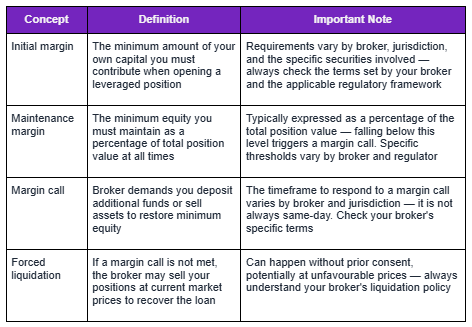
Note on jurisdiction: Specific margin requirements including initial margin percentages and maintenance thresholds differ between regulatory frameworks. US brokers operating under Regulation T and FINRA rules apply different requirements from Saudi CMA-regulated brokers. Always refer to your specific broker's margin terms and the rules of the regulator that governs your account.
Why Margin Is Especially Dangerous in Volatile Markets
Markets with concentrated sector exposure and commodity-price sensitivity create conditions where margin calls can hit hard and fast.
Saudi equity markets have historically shown sensitivity to oil price movements, given the significant weighting of energy-sector companies including Saudi Aramco. When commodity prices fall sharply, equity markets with high energy concentration can decline quickly and significantly. A leveraged investor in such a market during a sharp correction could face a margin call at exactly the moment when raising additional capital is most difficult — when asset prices are low and market uncertainty is high.
This is the structural problem with margin in volatile, concentrated markets: the events most likely to trigger margin calls are precisely the events that make meeting those calls hardest. Forced liquidation during a sharp decline can crystallise losses at unfavourable prices. Investors using a cash account are not subject to margin-call-driven liquidation, although they remain exposed to market losses and there is no guarantee that prices will recover.
Whether a specific investor using margin during a specific market event would receive a margin call depends on their entry price, the exact maintenance requirement applied, the composition of their portfolio, and the terms of their broker. The risk is real and should be understood in full before using leverage.
Important: You can lose more than your entire deposit in a margin account. If a position falls sharply enough, you will owe your broker money beyond what you originally invested. This is not a theoretical risk, it occurs in volatile markets.
Is Margin Trading Halal?
Conventional margin accounts involve interest charged on borrowed funds. Under Islamic finance principles, this constitutes riba — which is impermissible for Muslim investors.
Standard margin accounts charge a financing rate on the funds lent by the broker — typically expressed as an annual percentage, though rates vary significantly by broker, the amount borrowed, and prevailing market rates. This interest charge is classified as riba under Islamic finance and is impermissible for Muslim investors. For Saudi and GCC investors — the large majority of whom are Muslim — this is a primary screening criterion, not a secondary consideration.
Some brokers offer Sharia-compliant financing alternatives that are structured differently from conventional margin. One such structure is murabaha, a cost-plus financing arrangement in which the financier purchases an asset and sells it to the client at an agreed markup, rather than charging interest on a loan. This structure differs fundamentally from conventional interest-bearing margin in both form and contractual basis. Commodity murabaha is a common implementation used in Islamic finance markets.
A note of caution: the fact that a financing product is CMA-licensed does not by itself make it Sharia-compliant — licensing and Sharia compliance are assessed under separate frameworks. If you require Sharia-compliant leverage, verify that the specific product has been approved by a named, qualified Sharia supervisory board and review the underlying contract structure. Consult a qualified Sharia adviser if you are uncertain.
A Margin Account vs a Cash Account — A Simple Comparison
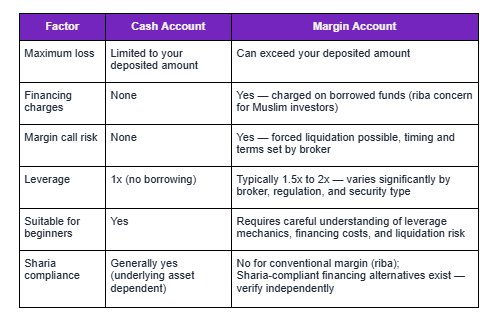
For investors who want to understand where margin fits in the overall risk spectrum, our understanding risk in stock trading guide provides the full risk framework in GCC context.
Frequently Asked Questions
Q: What is the difference between a margin account and a leveraged ETF?
A leveraged ETF (such as a 2x S&P 500 ETF) uses internal derivatives to provide leverage within the fund structure — you do not personally borrow money, and you cannot lose more than your investment. A margin account involves personally borrowing from your broker, creating the risk of losses exceeding your investment and financing charges on the borrowed amount. Both involve leverage risk, but the mechanics, costs, and loss profile differ significantly. Many leveraged ETFs target a multiple of daily returns and reset daily, so their performance over longer periods can differ significantly from the stated multiple because of compounding, particularly in volatile markets.
Q: At what point does a broker issue a margin call?
A margin call is triggered when your account equity falls below the maintenance margin requirement set by your broker. As an illustration of the mechanics: if you borrow SAR 10,000 to buy SAR 20,000 in stocks, your starting equity is SAR 10,000 (50% of position value).If the stocks fall to approximately SAR 13,333, your equity would be approximately SAR 3,333, or about 25% of the position value. If the position value falls below this level, the equity ratio would fall below a 25% maintenance requirement, which could trigger a margin call or liquidation action under the broker's terms.
Q: Does Raseed offer margin accounts?
Raseed is a direct stock ownership platform — you own the underlying securities without leverage. Margin accounts are not part of Raseed's standard offering. This means Raseed investors have no risk of margin calls or of losing more than their deposited capital on equity positions.
Q: What should I do if I have been using margin and want to reduce my risk?
Reducing margin exposure requires careful planning — rapidly selling all margin positions simultaneously during a downturn can itself amplify losses if prices are already depressed. Key considerations when reducing margin usage: understand your current maintenance requirement and how much buffer you have before a margin call threshold is reached; factor in the ongoing financing cost of maintaining borrowed positions; be aware that your broker retains the right to liquidate positions if the maintenance requirement is breached; and consider the tax and transaction cost implications of closing positions. There is no universally correct sequence for reducing margin exposure — the right approach depends on your specific position composition, portfolio size, financing costs, and market conditions. If you are uncertain, speak with a qualified financial adviser before making changes.
→ Invest in real stocks with real ownership on Raseed — no margin, no leverage, no margin call risk
Related Articles on Raseed Invest Learn
Disclaimer
This article is for educational and informational purposes only. It is not investment advice, nor a recommendation, offer or solicitation to buy or sell any security or digital asset. Investing involves risk, including possible loss of principal. Past performance does not guarantee future results.
Securities brokerage services are provided by Fullerverse (SC) Limited, a securities broker-dealer licensed and regulated by the Financial Services Authority of Seychelles (Licence No. SD152). Fullerverse (SC) Limited is a wholly-owned subsidiary of Raseed Invest Inc. Registered address: House of Francis, Room 302, Ile Du Port, Mahe, Seychelles.
Cryptocurrency services are made available by Raseed Crypto LLC ("Raseed Crypto"), a FinCEN-registered money services business (MSB Registration No. 31000316890439) and a wholly-owned subsidiary of Raseed Invest Inc. Cryptocurrencies are not stocks and your cryptocurrency investments are not protected by either FDIC or SIPC. Cryptocurrency is highly speculative in nature and involves a high degree of risk, including volatile market price swings, market manipulation, flash crashes and cybersecurity risks. Cryptocurrency regulations are continuously evolving, and it is your responsibility to understand and abide by them. Cryptocurrency trading can lead to large, immediate and permanent loss of financial value. You should have appropriate knowledge and experience before engaging in cryptocurrency trading. For additional information, please see our Crypto Risk Disclosures (https://files.raseedcapital.com/disclosures/library/CryptoRiskDisclosures.pdf).
Cryptocurrency services are not offered by, and are not available through, Raseed Invest Limited, which is regulated by the Dubai Financial Services Authority. Products and services referenced in this article are not available in all jurisdictions and are not directed at any person in a jurisdiction where their offer or availability would be contrary to local law or regulation.