A Complete Comparison for Saudi and GCC Investors in 2026
Quick Answer: Mutual Funds or ETFs — Key Differences for Saudi Investors
ETF fees vary widely by fund — passive index ETFs often carry expense ratios well below 0.50%, while actively managed ETFs can be higher; always check the specific fund's expense ratio before investing
S&P's SPIVA reports consistently show that large proportions of actively managed funds underperform their benchmarks over long periods — though results vary by category, time horizon, and market. Refer to the specific SPIVA scorecard for the relevant region and period
ETFs trade in real time on stock exchanges like any stock — mutual funds are priced once per day at closing NAV (Net Asset Value)
Both product types have Sharia-compliant versions: SPUS and HLAL are examples of Sharia-screened ETFs; multiple CMA-licensed Sharia mutual funds are available in the Saudi market
Whether an ETF or mutual fund suits you better depends on your goals, investment horizon, cost sensitivity, and Sharia requirements — neither is universally the right choice for every investor
Mutual funds and ETFs both pool investor money into a diversified collection of assets — but they differ in how they are managed, traded, priced, and what they cost.
The difference matters for GCC investors because cost differentials compound meaningfully over time. Fees, liquidity, management style, and Sharia-compliance options all vary between the two structures. This guide covers each dimension clearly so you can evaluate which structure fits your situation.
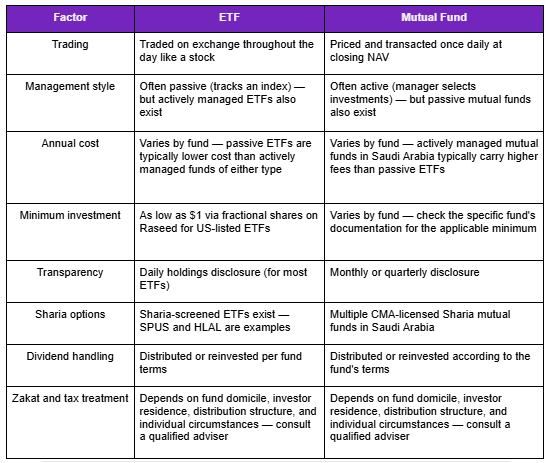
Key Differences: ETF vs Mutual Fund
Both ETFs and mutual funds can be actively or passively managed — the table below reflects the most common structures, not universal rules.
The Cost Compounding Effect — Why Fees Matter
Small fee differences between funds can compound into significant wealth differences over time.
As an illustrative example: if two investors each put SAR 100,000 into funds returning 8% gross per year, but one pays 0.25% annually in fees and the other pays 1.75% annually, the fee drag compounds meaningfully over 20 years. Using standard annual compound growth calculations, at 7.75% net the portfolio would grow to approximately SAR 445,000, while at 6.25% net it would grow to approximately SAR 336,000 — a difference of roughly SAR 109,000 attributable to the difference in assumed annual fees. Actual figures will differ based on the exact fees, return assumptions, and timing of contributions used.
This illustrates why costs matter but cost is one factor among several. A higher-cost fund with genuinely differentiated expertise in a specific market may justify its fees in some cases. The key question is always whether the active manager's returns after fees are likely to exceed what a passive alternative would deliver.
S&P's annual SPIVA reports track how actively managed funds perform relative to their benchmarks. The data consistently shows that across many categories and time periods, significant proportions of actively managed funds underperform their benchmarks, though results vary by region, asset class, and time horizon. For the most relevant comparison, consult the specific SPIVA scorecard for the market and category you are evaluating at spglobal.com/spdji/en/research-insights/spiva.
For a broader guide on diversification strategies, see our 5 Steps to Diversify Your Portfolio.
When a Mutual Fund May Be More Suitable Than an ETF
There are specific circumstances where a Saudi mutual fund may offer features that better suit an investor's needs than an ETF.
Saudi investors may prefer a mutual fund when: no liquid ETF exists for their specific desired exposure (for example, a Saudi small-cap growth strategy); the fund provides SAR-denominated automatic dividend reinvestment without currency conversion; a specific named Sharia board certification from an identified Saudi scholar is required; or the investor wants professional active management in a specific niche where genuine expertise exists.
The Saudi mutual fund market includes CMA-licensed Sharia-compliant funds from major asset managers including Derayah, Jadwa Investment, and SNB Capital. These funds may offer features such as SAR denomination, domestic regulatory oversight, and fund-specific Sharia governance. The exact structure, currency, Sharia oversight, fees, and distribution policy vary by fund and should be verified in the fund's current documentation.
For investors specifically interested in Sharia-compliant ETF options, our best halal ETFs guide for Saudi investors covers SPUS, HLAL, and other Sharia-screened funds with methodology details and current data.
Sharia-Compliant Options: ETFs and Mutual Funds
Both ETFs and mutual funds have Sharia-compliant versions — the right choice depends on your specific compliance requirements.
For ETF investors seeking Sharia compliance, two widely referenced options are:
SPUS (SP Funds S&P 500 Sharia Industry Exclusions ETF) — seeks to track the S&P 500 Sharia Industry Exclusions Index, which applies Sharia business-activity and financial-ratio screening together with specified industry exclusions. Review the fund's current prospectus and index methodology for the detailed screening criteria.
HLAL (Wahed FTSE USA Shariah ETF) — seeks to track the FTSE Shariah USA Index. The index applies Sharia screening undertaken by Yasaar Limited. Review the fund's current prospectus and index methodology for the detailed screening criteria.
Note: SPUS and HLAL apply different Sharia-screening methodologies. Do not assume they are interchangeable, review each fund's documentation and, where relevant, obtain guidance from a qualified Sharia adviser before investing.
Regarding the iShares MSCI Saudi Arabia ETF (ticker: KSA): This fund tracks the MSCI Saudi Arabia IMI 25/50 Index, which includes major TASI constituents such as Saudi Aramco and Al Rajhi Bank. It is a market-cap-weighted index fund providing broad Saudi equity exposure. It is not marketed as a dedicated Sharia-compliant or ESG fund, and should not be evaluated or described as one. Investors requiring Sharia or ESG screening should look to specifically screened alternatives.
For Sharia-compliant mutual funds providing domestic Saudi market exposure, review the fund's official terms, factsheet, and Sharia documentation, and verify that its fund manager is authorised by the CMA.
→ Explore Sharia-screened ETFs and US stocks on Raseed Invest
Frequently Asked Questions
Q: Is the iShares MSCI Saudi Arabia ETF (KSA) Sharia-compliant?
No. The iShares MSCI Saudi Arabia ETF (KSA) tracks the MSCI Saudi Arabia IMI 25/50 Index and provides broad exposure to Saudi-listed equities. It is not marketed as a Sharia-compliant fund and does not apply dedicated AAOIFI or other Islamic finance screening criteria. Investors requiring Sharia compliance should use specifically screened alternatives such as SPUS or HLAL, or CMA-licensed Sharia mutual funds. Always review a fund's prospectus and methodology documentation before investing.
Q: What is the minimum investment for an ETF on Raseed?
Raseed supports fractional share investing from $1 for US-listed ETFs available on the platform. You do not need to buy a full ETF unit. Confirm current minimum investment details directly on the platform, as terms may be updated over time.
Q: Should a Saudi beginner start with ETFs or individual stocks?
This depends on your individual goals, knowledge level, time available for research, and risk tolerance — there is no single answer that suits every investor. That said, broad index ETFs offer built-in diversification across many companies in a single purchase, which some beginners find useful as a starting point compared to selecting individual stocks. Individual stocks can be added over time as your research skills develop. Speak with a qualified financial adviser if you are unsure which approach fits your circumstances.
→ Open your Raseed Invest account and explore ETFs available on the platform
Related Articles on Raseed Invest Learn
Disclaimer
This article is for educational and informational purposes only. It is not investment advice, nor a recommendation, offer or solicitation to buy or sell any security or digital asset. Investing involves risk, including possible loss of principal. Past performance does not guarantee future results.
Securities brokerage services are provided by Fullerverse (SC) Limited, a securities broker-dealer licensed and regulated by the Financial Services Authority of Seychelles (Licence No. SD152). Fullerverse (SC) Limited is a wholly-owned subsidiary of Raseed Invest Inc. Registered address: House of Francis, Room 302, Ile Du Port, Mahe, Seychelles.
Cryptocurrency services are made available by Raseed Crypto LLC ("Raseed Crypto"), a FinCEN-registered money services business (MSB Registration No. 31000316890439) and a wholly-owned subsidiary of Raseed Invest Inc. Cryptocurrencies are not stocks and your cryptocurrency investments are not protected by either FDIC or SIPC. Cryptocurrency is highly speculative in nature and involves a high degree of risk, including volatile market price swings, market manipulation, flash crashes and cybersecurity risks. Cryptocurrency regulations are continuously evolving, and it is your responsibility to understand and abide by them. Cryptocurrency trading can lead to large, immediate and permanent loss of financial value. You should have appropriate knowledge and experience before engaging in cryptocurrency trading. For additional information, please see our Crypto Risk Disclosures (https://files.raseedcapital.com/disclosures/library/CryptoRiskDisclosures.pdf).
Cryptocurrency services are not offered by, and are not available through, Raseed Invest Limited, which is regulated by the Dubai Financial Services Authority. Products and services referenced in this article are not available in all jurisdictions and are not directed at any person in a jurisdiction where their offer or availability would be contrary to local law or regulation.