

A Plain-Language Guide for Saudi and GCC Investors
Quick Answer: What Is Short Selling?
Short selling means borrowing shares you do not own, selling them immediately, and hoping the price falls so you can buy them back cheaper and return them, keeping the difference as profit
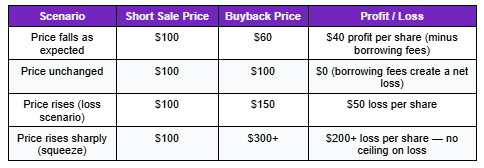
Short selling carries theoretically unlimited loss potential, if a stock price rises instead of falling, there is no ceiling on how much you can lose
In a "short squeeze," investors who shorted a stock are forced to buy shares quickly to cover losses, driving the price even higher, GameStop (GME) is the most famous recent example
Short selling is generally not available to retail investors through standard brokerage accounts, it requires a margin account and specific regulatory approval
For most Saudi and GCC retail investors, understanding short selling matters more as market context than as a strategy to practise
Short selling is the practice of selling shares you do not own, borrowing them from a broker, with the expectation that the price will fall so you can buy them back at a lower price and profit from the difference.
It is the opposite of the standard investing approach (buy low, sell high). In short selling, you sell first and buy later, profiting when prices fall. It is a recognised strategy in some regulated markets, used by hedge funds and sophisticated institutional investors for hedging and speculation. But it carries a risk that makes it fundamentally different from standard equity investing: your maximum gain is capped (a stock can only fall to zero) but your maximum loss is theoretically unlimited (a stock can rise indefinitely).
For Saudi and GCC retail investors, the primary value in understanding short selling is not to practise it, most standard brokerage accounts do not offer short selling functionality, and the risks are inappropriate for most retail investors. The value is in understanding why stocks sometimes move in counterintuitive ways, what "short interest" means when you see it in news, and what a short squeeze is when it affects a stock you hold.
How Short Selling Works — Step by Step
Short selling involves four steps: borrow, sell, wait, and buy back.
Borrow: You borrow shares from your broker (who lends them from their own inventory or other clients' holdings). You pay an ongoing borrowing fee. Borrowing fees can vary widely depending on share availability, market conditions, and broker policy.
Sell: You immediately sell the borrowed shares at the current market price. Cash from the sale is held as collateral.
Wait: You hold the short position, paying borrowing fees. If the price falls as you expected, your position is profitable. If it rises, your position loses money.
Buy back (cover): You buy shares in the open market to return to the lender. If you bought cheaper than you sold, you profit. If you bought more expensively, you absorb a loss.
Short Squeezes — What They Are and Why They Matter
A short squeeze is one of the most violent price movements in financial markets, and it is caused by short sellers being forced to buy.
When a heavily shorted stock starts rising unexpectedly, short sellers face growing losses. As losses mount, brokers issue margin calls requiring them to add collateral or close their positions. Closing a short position means buying shares and when many short sellers are forced to buy simultaneously, their buying pushes the price even higher, forcing more short sellers to cover, creating a feedback loop.
GameStop (GME) in January 2021 is the most cited example. Heavy retail buying associated with discussions on Reddit’s WallStreetBets forum contributed to the extreme price move and short-squeeze dynamics that took GME from $17 to an intraday high of $483 in January 2021. Short sellers collectively lost billions. The SEC later published a detailed report on the event, noting that GME short interest was unusually high and exceeded 100% of shares outstanding around the end of 2020, creating a highly sensitive setup for sharp price moves.
The concepts around short selling, particularly how borrowed shares and margin interact — connect directly to margin investing. Our margin investing guide for GCC investors covers the related risks in more accessible detail.
Is Short Selling Halal?
Short selling is generally considered impermissible under Islamic finance principles because it involves selling something you do not own.
The Islamic finance prohibition on selling what you do not own applies directly to conventional short selling. In a conventional short sale, the investor sells borrowed shares that they do not own at the time of sale, which conflicts with the ownership requirement for a valid Islamic sale. According to AAOIFI Shariah Standard No. 21 on financial papers, it is not permissible to sell shares that the seller does not own. Based on this, many Islamic finance scholars and institutions view conventional short selling as incompatible with Shariah principles. Investors seeking Shariah compliance should avoid conventional short selling or consult a qualified Shariah adviser before using any similar structure.
Some derivatives-based strategies that achieve similar economic outcomes to short selling exist in Islamic finance, but these require specific fatwa-backed structures not commonly available to retail investors. For the vast majority of GCC retail investors, short selling is both impractical (not available on standard accounts) and impermissible (under Islamic finance principles).
Frequently Asked Questions
Q: Can I short sell stocks through Raseed?
Raseed is a direct stock ownership platform — you own the underlying securities without leverage. Short selling is not available through Raseed. The platform is designed for direct long investment in real assets.
Q: What does "short interest" mean when I see it in stock news?
Short interest is the percentage of a company's available shares that are currently sold short. High short interest (above 20% of float) means many investors are betting the stock will fall. If the stock rises instead, high short interest can fuel a short squeeze. Short interest data is publicly available for US-listed stocks through FINRA and is published bi-weekly.
Q: Is short selling legal in Saudi Arabia?
Covered short selling — where the shares are borrowed, or the seller has an exercisable and unconditional right to borrow them before selling — is permitted on the Saudi Exchange within a defined regulatory framework. Practical access may vary depending on the broker, account type, and applicable regulatory requirements. Uncovered or naked short selling is not permitted under the covered short-selling framework.
Q: Why would anyone short sell if the losses are unlimited?
Professional short sellers use strict risk management rules including stop-loss orders that automatically close positions at predetermined loss levels, position sizing that limits any single short to a small percentage of portfolio, and hedging through other positions. The unlimited theoretical loss is real, but professional short sellers do not allow losses to run without limit.
Invest in real stock ownership on Raseed — no borrowing, no short selling, no leverage. From $1. → Start with real stock ownership on Raseed →
Related Articles on Raseed Learn
What Is Margin Investing and Why GCC Beginners Should Avoid It
Understanding Risk in Stock Trading
Most Common Investing Mistakes GCC Beginners Make
This article is for educational and informational purposes only and does not constitute investment advice. All investing involves risk, including the potential loss of principal. Data sourced from publicly available primary sources as of June 2026. Past performance does not guarantee future results. Securities brokerage services are provided by Fullerverse (SC) Limited, licensed and regulated by the Financial Services Authority Seychelles (Licence No. SD152), a wholly-owned subsidiary of Raseed Invest Inc. Raseed Invest Limited is regulated by the DFSA. Capital is at risk.