Quick Answer: What Are the Options Greeks?
- The Greeks are measures that estimate how an option's price may change when one factor changes, such as the stock price, time or volatility.
- Delta estimates how much the option price moves for a $1 move in the underlying stock.
- Gamma estimates how much delta itself changes for a $1 move in the stock.
- Theta estimates how much value an option loses each day as expiration approaches.
- Vega estimates the price change for a 1 percentage-point change in implied volatility, and rho for a 1 percentage-point change in interest rates.
- The Greeks are theoretical estimates from pricing models. They change constantly and do not guarantee any result.
What You Will Learn
- What each of the five main Greeks measures
- Typical values for calls and puts, with simple examples
- How the Greeks change near expiration
- How traders use the Greeks together
- The limits of the Greeks and common mistakes
What Are the Options Greeks?
The options Greeks are risk measures that show how sensitive an option's price is to changes in the stock price, time, volatility and interest rates. Each Greek isolates one factor and assumes the others stay the same.
They are called "Greeks" because most are named after Greek letters. If you are new to options, start with our beginner's guide to options trading and our guide to strike price and premium.
Remember that one standard US stock option contract usually covers 100 shares, so a Greek of 0.40 per share means about $40 per contract.
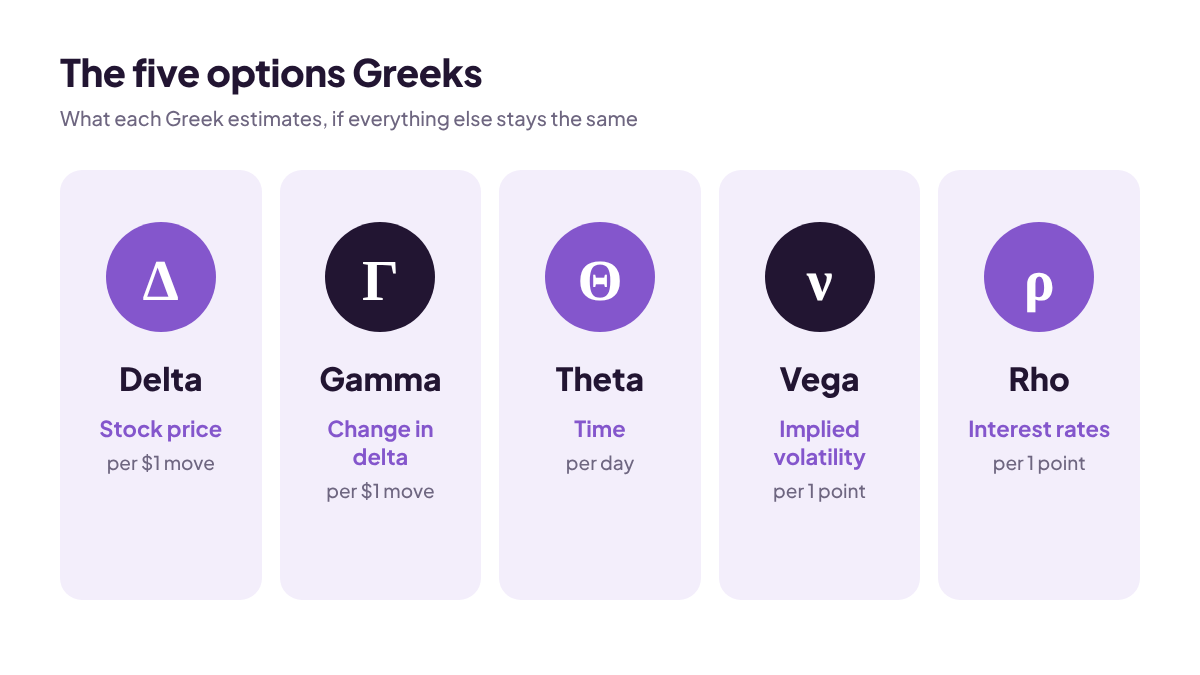
The five options Greeks and what each one estimates
The Five Main Greeks at a Glance
| Greek | Measures the Change in Option Price for… | Long Call | Long Put |
|---|---|---|---|
| Delta | A $1 move in the stock | Positive (0 to 1) | Negative (0 to −1) |
| Gamma | How fast delta changes per $1 move | Positive | Positive |
| Theta | Each day that passes | Negative | Negative |
| Vega | A 1 percentage-point change in implied volatility | Positive | Positive |
| Rho | A 1 percentage-point change in interest rates | Positive | Negative |
Delta: Sensitivity to the Stock Price
Delta estimates how much an option's price should move for every $1 change in the underlying stock.
- Call deltas range from 0 to 1; put deltas range from 0 to −1.
- An at-the-money option usually has a delta near 0.50 (or −0.50 for a put).
- Deep in-the-money options move closer to 1 (or −1); far out-of-the-money options move closer to 0.
Example: a call with a delta of 0.40 would theoretically rise by about $0.40 per share, or about $40 per contract, if the stock rises by $1.
Many traders also use delta as a rough guide to the chance an option will finish in the money. A 0.40 delta is often read as about a 40% chance. But finishing in the money is not the same as making a profit, because you also paid a premium.
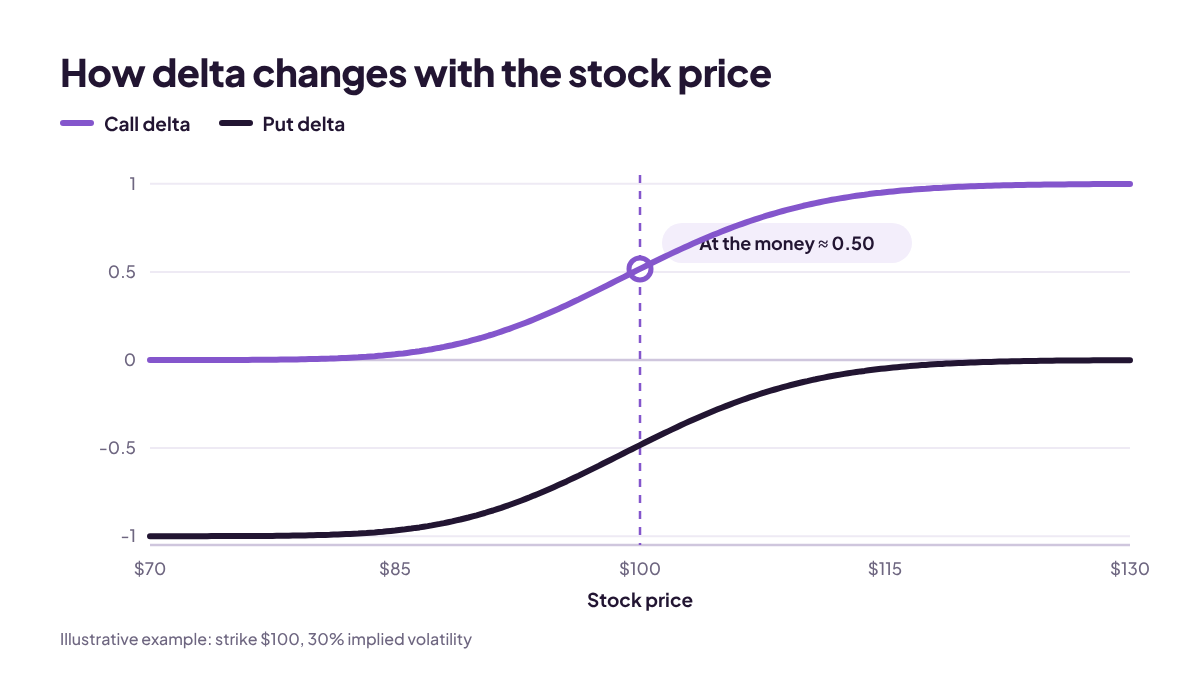
Call delta rises from 0 towards 1 and put delta from −1 towards 0 as the stock price rises
Gamma: How Fast Delta Changes
Gamma estimates how much delta changes for every $1 move in the stock.
Example: if a call's delta rises from 0.40 to 0.55 after a $1 rise in the stock, the gamma is about 0.15.
Gamma is usually highest for at-the-money options and becomes more pronounced as expiration gets closer. That is why short-dated options can change in value very quickly.
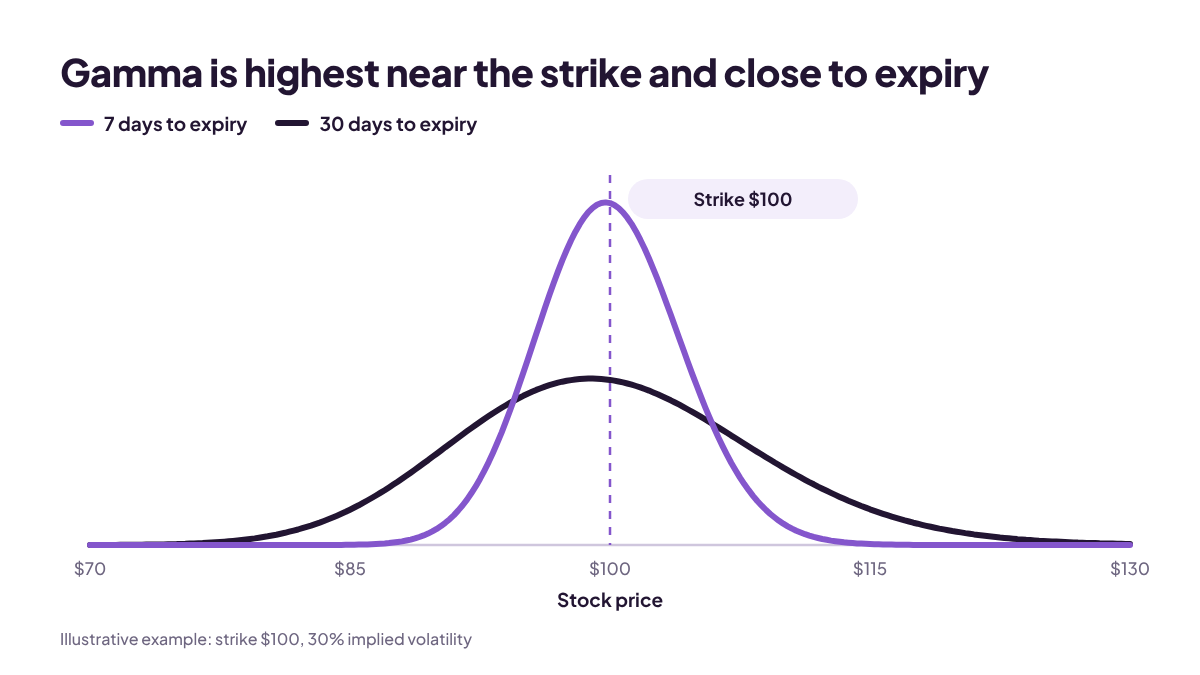
Gamma peaks near the strike price and rises as expiration approaches
Theta: The Cost of Time
Theta estimates how much value an option loses each day, if everything else stays the same. For buyers of calls and puts, theta is negative.
Example: an option with a theta of −0.02 would theoretically lose about $0.02 per share each day, or about $2 per contract, including weekends.
Time decay tends to speed up as expiration approaches, so options can lose value faster in their final weeks.
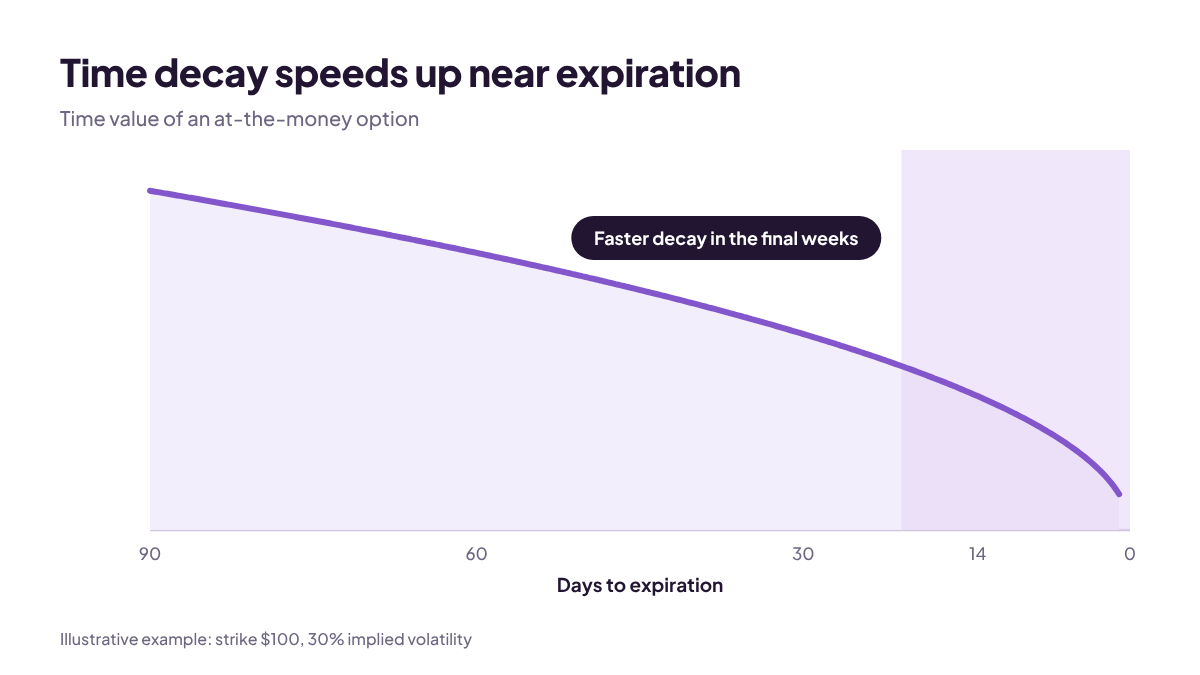
The time value of an at-the-money option falls faster in the final weeks
Vega: Sensitivity to Volatility
Vega estimates how much an option's price changes for every 1 percentage-point change in implied volatility. Both calls and puts have positive vega, so rising implied volatility tends to increase their value, and falling volatility tends to reduce it.
Example: with a vega of 0.10, a 1-point rise in implied volatility would theoretically add about $0.10 per share, or about $10 per contract.
Vega matters most around events that can move volatility, such as earnings reports. Learn how to read them in our guide to earnings reports.
Rho: Sensitivity to Interest Rates
Rho estimates how much an option's price changes for every 1 percentage-point change in interest rates. Calls have positive rho and puts have negative rho. For most short-term options, rho is a small factor, but longer-dated options are more sensitive to rate changes.
How Traders Use the Greeks Together
The Greeks work best as a set, not one at a time:
- Delta shows how exposed you are to the stock's direction.
- Gamma shows how quickly that exposure can change.
- Theta shows what waiting costs you each day.
- Vega shows how exposed you are to changes in volatility.
For example, a buyer of a short-dated, at-the-money call usually faces high gamma and fast time decay, so the stock may need to move quickly for the trade to work.
Limits of the Greeks and Mistakes to Avoid
- Treating Greeks as guarantees. They are model estimates that assume all other factors stay the same.
- Looking at one Greek only. A good delta does not help much if theta and falling volatility work against you.
- Forgetting that Greeks change. They shift as the stock moves, time passes and volatility changes.
- Ignoring the premium. An option can finish in the money and still lose money once the premium is counted.
- Taking on more risk than you can afford. Buyers of options can lose the entire premium paid. Read our guide to understanding risk in stock trading, and review the "Characteristics and Risks of Standardized Options" document before trading options.
Related Articles on Raseed Learn
What Is Options Trading? · Understanding Strike Price and Premium · What Are Covered Calls?
See the Greeks before you trade
View live prices, bid/ask spreads and Greeks on US stock options with Raseed. Options fees are $0.99 per contract, with a $1.49 minimum per transaction.
Explore Options on Raseed →Frequently Asked Questions
Disclaimer
This article is for educational and informational purposes only. It is not investment advice, nor a recommendation, offer or solicitation to buy or sell any security or digital asset. Investing involves risk, including possible loss of principal. Past performance does not guarantee future results.
Securities brokerage services are provided by Fullerverse (SC) Limited, a securities broker-dealer licensed and regulated by the Financial Services Authority of Seychelles (Licence No. SD152). Fullerverse (SC) Limited is a wholly-owned subsidiary of Raseed Invest Inc. Registered address: House of Francis, Room 302, Ile Du Port, Mahe, Seychelles.
Cryptocurrency services are made available by Raseed Crypto LLC ("Raseed Crypto"), a FinCEN-registered money services business (MSB Registration No. 31000316890439) and a wholly-owned subsidiary of Raseed Invest Inc. Cryptocurrencies are not stocks and your cryptocurrency investments are not protected by either FDIC or SIPC. Cryptocurrency is highly speculative in nature and involves a high degree of risk, including volatile market price swings, market manipulation, flash crashes and cybersecurity risks. Cryptocurrency regulations are continuously evolving, and it is your responsibility to understand and abide by them. Cryptocurrency trading can lead to large, immediate and permanent loss of financial value. You should have appropriate knowledge and experience before engaging in cryptocurrency trading. For additional information, please see our Crypto Risk Disclosures (https://files.raseedcapital.com/disclosures/library/CryptoRiskDisclosures.pdf).
Cryptocurrency services are not offered by, and are not available through, Raseed Invest Limited, which is regulated by the Dubai Financial Services Authority. Products and services referenced in this article are not available in all jurisdictions and are not directed at any person in a jurisdiction where their offer or availability would be contrary to local law or regulation.