

A Practical Guide to Quarterly Results Analysis for Saudi and GCC Investors
Quick Answer: What Should You Look for in an Earnings Report?
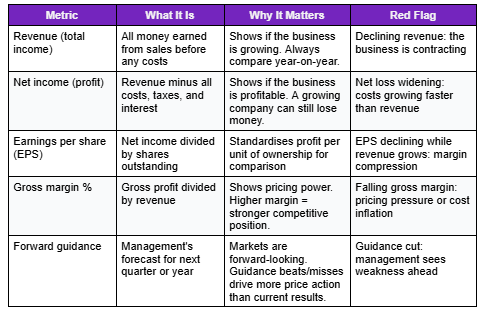
The five most important numbers in any earnings report are: revenue (total income), net income (profit after all costs), EPS (earnings per share), gross margin (%), and forward guidance (management’s forecast for the next quarter or year)
Revenue above or below analyst consensus estimates often drives immediate stock price movement more than the absolute revenue number itself
EPS "beats" and "misses" are relative to analyst expectations, a company can report positive EPS and see its stock fall if the number missed consensus forecasts
Forward guidance is often more important than current results, investors price the future, not the past
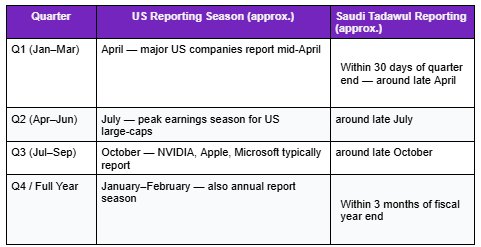
For TASI stocks, interim financial results are published quarterly on the Saudi Exchange website; US companies file quarterly results with the SEC on Form 10-Q, typically within 40 to 45 days of quarter end, depending on filer status.
An earnings report is a company's official quarterly or annual financial performance disclosure and it is the single most important recurring information event in an investor's calendar.
Every publicly listed company is required to publish its financial results regularly. In Saudi Arabia, companies listed on Tadawul publish interim results quarterly, overseen by the CMA. US-listed companies file quarterly results on Form 10-Q and annual results on Form 10-K with the SEC, with filing deadlines that vary by filer status. Quarterly reports are typically due within 40 to 45 days, while annual reports are typically due within 60 to 90 days. These reports contain the raw data from which investors determine whether a business is growing, profitable, and managing its capital efficiently.
For GCC investors who own both TASI stocks and US-listed companies through Raseed, understanding how to read earnings reports in both formats is a foundational investment skill. The good news: despite different formatting and regulatory frameworks, the core financial metrics that matter are universal.
The 5 Most Important Numbers in Every Earnings Report
Every earnings report contains many numbers. These five tell you almost everything you need to know in 5 minutes.
Monitor earnings of your US and Saudi stock holdings in real time through the Raseed app. → Open your Raseed account and start building your portfolio →
Beats and Misses — Why Expectations Matter More Than Absolute Numbers
A company can report $5 billion in profit and see its stock fall 10%, if analysts expected $5.5 billion.
Before each earnings release, financial analysts who cover a stock publish their estimates for revenue and EPS. These estimates aggregate into a "consensus" figure tracked by data providers like Bloomberg and FactSet. When a company reports above consensus (a "beat"), the stock typically rises. Below consensus (a "miss") typically causes a decline. These reactions happen because the stock price before the report already reflected the expected results, the beat or miss is new information.
A real example: Palantir Technologies reported Q1 2026 revenue of $1.633 billion, representing 85% year-on-year growth. US commercial revenue grew 133% year-on-year. This significantly exceeded analyst consensus and Palantir's stock responded positively. Separately, the company raised full-year 2026 revenue guidance from approximately $7.18–$7.20 billion to $7.65–$7.66 billion. The guidance raise was arguably more impactful than the beat itself, because it told investors that the growth was accelerating, not slowing.
For practical context on how earnings data translates into stock valuation, see our P/B ratio, EPS, and ROE valuation metrics guide, which covers how to use earnings report numbers in a full stock analysis.
How to Read a TASI Earnings Report
Saudi Exchange interim results follow a different format from US SEC filings, but the same five metrics apply.
TASI-listed companies publish their financial results through the Saudi Exchange disclosure platform. Results are published in Arabic and English. The primary financial document is the interim condensed consolidated financial statements. Key differences from US format: Saudi companies report in SAR, follow IFRS (International Financial Reporting Standards) accounting, and the fiscal year follows the Gregorian calendar. Some Islamic banks also publish Sharia supervisory board reports alongside their financial statements.
When reading a TASI earnings report, specifically look for: Operating profit excluding Zakat (Zakat is treated as a tax line for Saudi companies, not a business cost); Return on equity for banks (the primary profitability metric for Saudi financial institutions); and Non-performing loan ratio for banks (a key risk metric absent from non-financial company reports).
The Earnings Calendar — When to Watch for Results
Earnings season is predictable — mark these windows in your calendar if you hold stocks through Raseed.
Frequently Asked Questions
Q: Where do I find earnings reports for US stocks I own through Raseed?
US company earnings reports are filed with the SEC and available free at sec.gov/edgar. The SEC's EDGAR database contains all 10-Q and 10-K filings. Most financial news platforms (Bloomberg, Reuters, Yahoo Finance) also publish earnings report summaries within minutes of release.
Q: Where do I find Saudi Tadawul company earnings?
Saudi Exchange listed company results are published on the Saudi Exchange official website (saudiexchange.sa) under the company's investor relations page. The CMA also maintains a disclosure database at cma.org.sa. Results are published in both Arabic and English.
Q: How do I know if earnings results are good or bad without knowing the analyst estimates?
Compare the reported numbers to the same quarter in the prior year (year-on-year growth), and to the previous quarter (sequential growth). If revenue is growing year-on-year and margins are stable or expanding, the business is performing well in absolute terms — regardless of whether it beat a specific analyst estimate.
Q: Should I buy or sell before an earnings report?
Trading around earnings reports is high-risk because market reaction depends on the result relative to expectations, which are difficult to predict. Long-term investors typically hold through earnings unless the reported numbers change their fundamental investment thesis. Short-term traders who trade earnings should understand that the risk of being wrong is significant, the stock can move sharply in either direction within minutes of release.
Related Articles on Raseed Learn
P/B Ratio, EPS, and ROE: Key Valuation Metrics
How to Research GCC Stocks: Fundamental Analysis
Best Tech Stocks for Saudi Investors 2026
Understanding Risk in Stock Trading
This article is for educational and informational purposes only and does not constitute investment advice. All investing involves risk, including the potential loss of principal. Data sourced from publicly available primary sources as of June 2026. Past performance does not guarantee future results. Securities brokerage services are provided by Fullerverse (SC) Limited, licensed and regulated by the Financial Services Authority Seychelles (Licence No. SD152), a wholly-owned subsidiary of Raseed Invest Inc. Raseed Invest Limited is regulated by the DFSA. Capital is at risk.