

An Options Income Strategy Explained for Saudi and GCC Investors
Quick Answer: What Is a Covered Call?
A covered call is when you sell someone the right to buy your shares at a fixed price (the strike price) before a set date, in exchange for immediate cash income called the option premium
"Covered" means you already own the underlying shares, the most important distinction from naked (uncovered) call writing, which carries unlimited risk
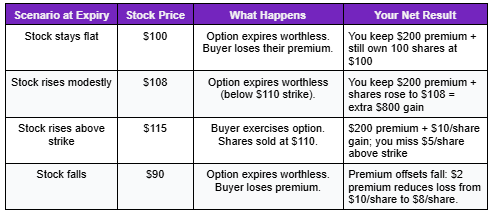
If the stock price stays below the strike price by expiry, the option expires worthless, you keep the premium, and you keep your shares, this is the ideal outcome for covered call writers
If the stock price rises above the strike price, your shares are "called away" sold at the strike price, meaning you miss any gains above that level
Covered calls can provide additional premium income that helps offset part of a stock’s decline, but they do not eliminate downside risk and they cap your upside. Making them unsuitable for stocks you believe will rise significantly in the short term
A covered call is one of the most widely used options strategies by income-seeking investors worldwide and one of the options strategies that beginner investors may encounter and should understand before considering any options-related product.
Here is the core idea: you already own 100 shares of a company. You sell someone else the right to buy those shares from you at a fixed price (the "strike price") at any time before a set expiration date. In exchange for granting this right, they pay you a cash premium immediately. That premium is yours to keep regardless of what happens next, it is immediate income on your existing shares.
The "covered" in the covered call refers to the fact that you own the underlying shares. This is critical. If the buyer of your call option exercises their right to buy shares, you already own the shares to deliver — you are "covered." This distinguishes covered calls from naked calls (selling calls without owning the shares), which carry theoretically unlimited loss potential and are appropriate only for sophisticated professional traders.
How a Covered Call Works — A Step-by-Step Example
The mechanics become clear with a concrete example using a stock at a specific price.
Imagine you own 100 shares of a US stock trading at $100 per share. You believe the stock will remain relatively flat or rise modestly over the next month. You decide to sell one call option contract (each contract covers 100 shares) with a strike price of $110 expiring in 30 days. The buyer pays you a premium of $2 per share, $200 total immediately deposited into your account.
Why GCC Investors Use Covered Calls
Covered calls appeal to investors who want to generate income from stocks they plan to hold long-term regardless of short-term price movement.
For a Saudi investor who owns shares in Apple, Microsoft, or a TASI blue-chip and does not plan to sell in the next 1–3 months, a covered call may generate additional option premium income from shares they already own. The premium received reduces the effective cost basis of the position over time. Selling covered calls regularly can generate additional premium income, but the amount varies widely and comes in exchange for capped upside.
Covered call ETFs, funds that systematically sell covered calls on their holdings and distribute the premium as income have grown significantly in popularity. Examples include QYLD and XYLD, which use covered-call or buy-write strategies. Availability to GCC investors depends on the broker, jurisdiction, and product eligibility rules.
For investors interested in structured income from their equity portfolio, covered call ETFs are a simpler starting point than individual option contracts. Our ETF vs Mutual Fund guide for GCC investors covers how to evaluate income-focused ETF strategies.
The Key Risks of Covered Calls
The primary risk is capping your upside, if you sell a covered call and the stock surges, you miss the gains above the strike price.
Capped upside: If you sell a call at $110 and the stock rises to $140, your shares are sold at $110. You miss $30 per share in gains above the strike. The premium you received ($2 in our example) is small consolation.
Assignment before expiry: American-style options can be exercised at any time before expiry, not just on the expiration date. If the stock rises sharply, your shares can be called away early.
Tax complexity: Option premiums, exercises, and assignments create tax events. Option premiums, exercises, and assignments may have tax or reporting implications depending on the investor’s country of residence, account type, underlying asset, and applicable tax rules. Investors should consult a qualified tax adviser.
Complexity requires learning: Options have their own terminology (delta, theta, implied volatility, strike, expiry) that requires time to understand properly. Mistakes in options contracts are typically irreversible.
Suitability warning: Covered calls are only appropriate for investors who fully understand the underlying stock they own, are comfortable with having those shares called away at the strike price, and have taken the time to understand option contract mechanics. Do not sell covered calls on a stock you have not researched fundamentally.
Is Selling Covered Calls Halal?
The Sharia compliance of options, including covered calls, is debated among Islamic scholars. Mainstream Islamic finance scholarship is cautious.
The majority view among Islamic finance scholars is that conventional options contracts are not permissible under Islamic law, primarily because they involve selling rights to future transactions (gharar, excessive uncertainty) and the option premium may be considered a form of speculation. However, minority scholarly opinions argue that covered calls, because they involve actual underlying asset ownership and the premium is for a real benefit granted, are closer to permissible structures. The AAOIFI has not issued a definitive ruling that clearly permits or prohibits covered calls for retail investors. Muslim investors with concerns should consult a qualified Islamic finance scholar before using covered call strategies.
Frequently Asked Questions
Q: How much income can I generate from covered calls?
Monthly covered call premiums typically represent 0.5–2% of the underlying stock value per month, depending on the stock's implied volatility and how close to the current price you set the strike. On a $10,000 stock position, this could be $50–$200 per month. Highly volatile stocks generate higher premiums but carry more risk of assignment.
Q: What happens to my covered call if the company pays a dividend?
Dividends can increase the likelihood of early assignment. Call option buyers sometimes exercise their options before the ex-dividend date to capture the dividend. If your covered call is exercised early, you will not receive the dividend — your shares are called away before the record date.
Q: Can I use covered calls on TASI stocks?
Options trading on TASI is limited and not broadly accessible to retail investors in the same way as US options markets. Covered call strategies are most commonly used by Saudi investors on US-listed stocks accessible through platforms like Raseed.
Q: What is a covered call ETF and is it better than doing covered calls myself?
Covered call ETFs like QYLD or XYLD systematically sell covered calls on their holdings and distribute the option income as monthly dividends. They require no options knowledge or margin account from the investor. The tradeoff is that they permanently cap upside on the underlying holdings. For beginner investors, covered call ETFs are simpler — but for investors who want to selectively cap upside only on specific positions, managing covered calls individually provides more control.
Access options trading and covered call ETFs on Raseed — US markets from Saudi Arabia, from $1. → Explore options and ETFs on Raseed →
Related Articles on Raseed Learn
ETF vs Mutual Fund for GCC Investors
Understanding Risk in Stock Trading
Passive Investing vs Active Trading
This article is for educational and informational purposes only and does not constitute investment advice. All investing involves risk, including the potential loss of principal. Data sourced from publicly available primary sources as of June 2026. Past performance does not guarantee future results. Securities brokerage services are provided by Fullerverse (SC) Limited, licensed and regulated by the Financial Services Authority Seychelles (Licence No. SD152), a wholly-owned subsidiary of Raseed Invest Inc.