Quick Answer: What Are Cyclical and Defensive Stocks?
- Cyclical stocks belong to companies whose sales and profits tend to rise and fall with the economy, such as carmakers, banks, airlines and hotels.
- Defensive stocks belong to companies that sell things people keep buying in good and bad times, such as food, medicine and electricity.
- Cyclical stocks often do better when the economy is growing and can fall harder in a slowdown.
- Defensive stocks tend to be steadier in a downturn but may lag when the economy is booming.
- Morningstar groups the stock market into three "super sectors": cyclical, sensitive and defensive.
- Neither type is always better. Many investors hold both to balance a portfolio.
What You Will Learn
- What cyclical and defensive stocks are, with examples
- Which sectors are usually seen as cyclical or defensive
- How the business cycle works and how sectors have tended to behave in each phase
- What sector rotation means and its limits
- How GCC investors can think about both types in a US portfolio
What Are Cyclical Stocks?
Cyclical stocks are shares of companies whose earnings closely follow the ups and downs of the economy. When jobs and incomes are growing, people spend more on cars, travel, new homes and big purchases, and businesses invest more. When the economy slows, those purchases are often the first to be cut.
Common examples include automakers, airlines, hotels, homebuilders, banks, chemical and steel producers, and retailers that sell non-essential goods. Their share prices can rise strongly in a recovery, but they can also fall sharply when growth weakens.
What Are Defensive Stocks?
Defensive stocks are shares of companies that sell essential products and services that people need regardless of the economy. Morningstar describes defensive industries as those that provide services consumers require "in both good and bad times".
Examples include food and household-goods makers, drug companies and hospitals, and electricity and water utilities. Their sales usually change less from year to year, so their share prices have tended to be steadier than the wider market during downturns. Many also pay regular dividends. If you are new to them, read our guide to all about dividends.
Defensive does not mean safe. These stocks can still fall in value, especially when interest rates rise or when investors pay too much for them.
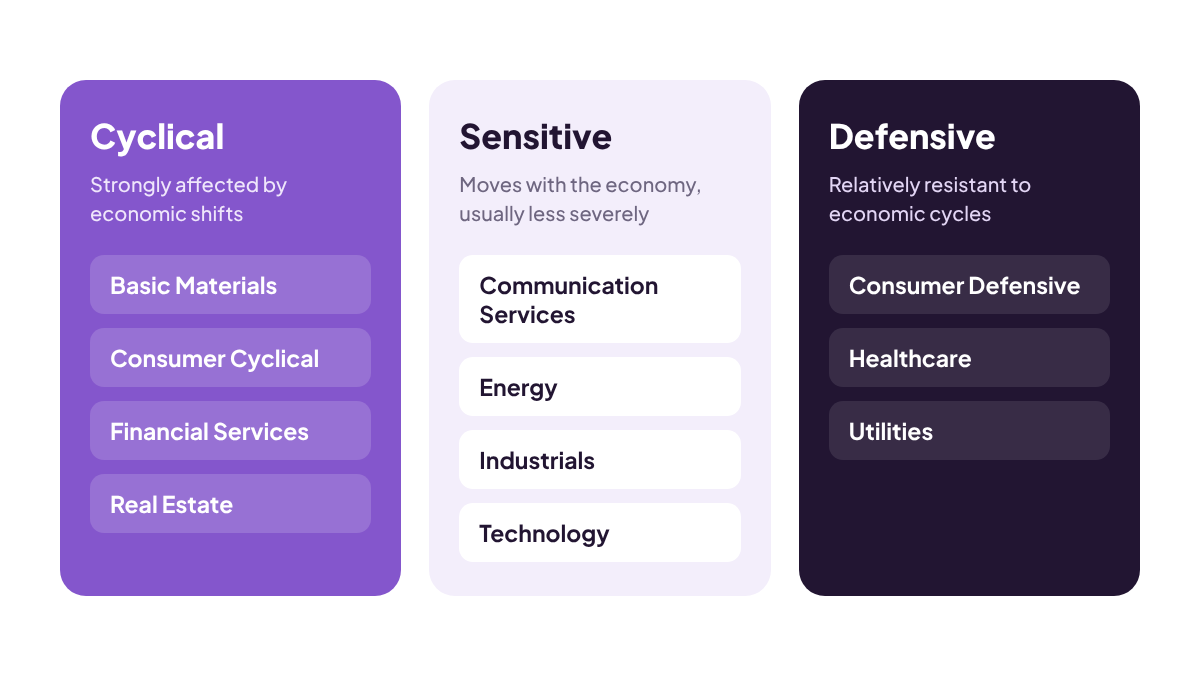
Cyclical, sensitive and defensive stocks, with the sectors in each group
Which Sectors Are Cyclical, Sensitive or Defensive?
Morningstar splits its 11 sectors into three super sectors based on how closely they follow the economy:
| Super Sector | How It Behaves | Sectors Included |
|---|---|---|
| Cyclical | Significantly affected by economic shifts | Basic Materials, Consumer Cyclical, Financial Services, Real Estate |
| Sensitive | Moves with the economy, but usually less severely | Communication Services, Energy, Industrials, Technology |
| Defensive | Relatively resistant to economic cycles | Consumer Defensive, Healthcare, Utilities |
Morningstar's "Consumer Cyclical" and "Consumer Defensive" match the "Consumer Discretionary" and "Consumer Staples" sectors used in the GICS system.
How the Business Cycle Works
The business cycle is the pattern of expansion and contraction in the economy. According to the US National Bureau of Economic Research (NBER), expansions run from a trough to a peak, and recessions run from a peak to a trough. NBER defines a recession as a significant decline in economic activity that is spread across the economy and lasts more than a few months.
Fidelity notes that, since 1945, the average US expansion has lasted around five years and four months, while the average contraction has lasted a little more than 10 months. Expansion is the normal state of the economy, but no two cycles are the same.
Fidelity breaks the cycle into four phases: early cycle, mid cycle, late cycle and recession.
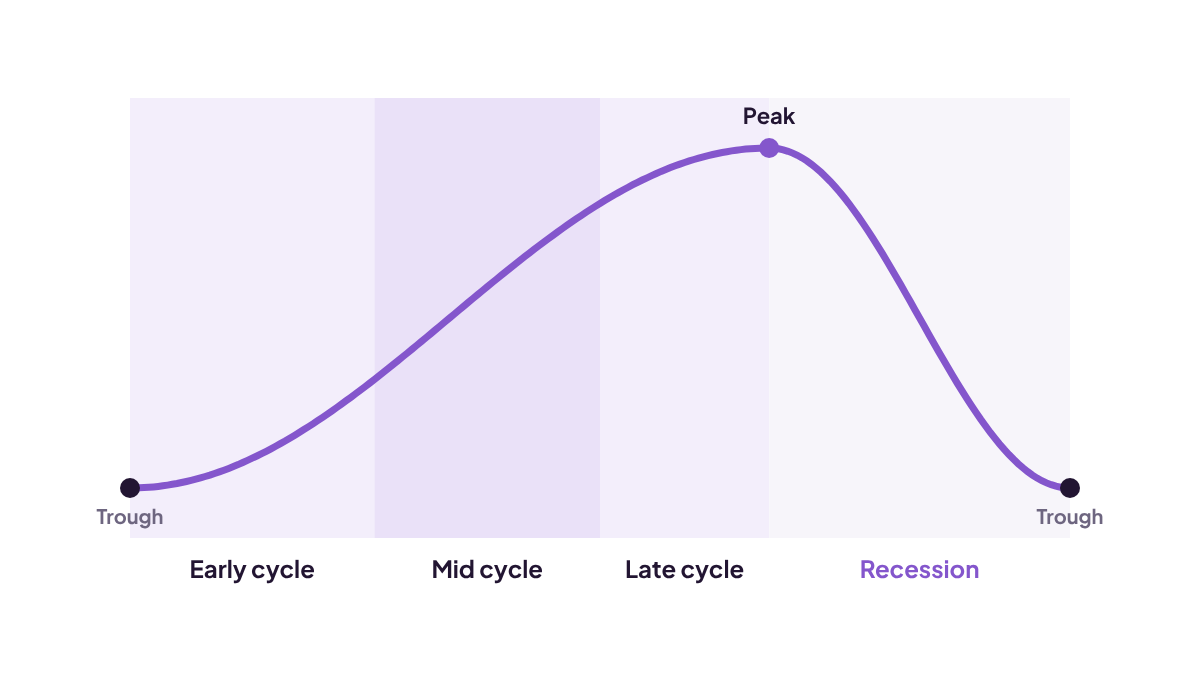
The four phases of the business cycle: early, mid, late and recession
How Sectors Have Tended to Behave in Each Phase
| Phase | What Usually Happens | Sectors That Have Historically Tended to Lead |
|---|---|---|
| Early cycle | The economy recovers and interest rates are often low | Consumer discretionary, financials, industrials, technology, materials |
| Mid cycle | Growth continues at a steadier pace | Technology, industrials |
| Late cycle | Growth slows and inflation pressures can build | Energy, materials, health care, consumer staples, utilities |
| Recession | Activity contracts | Consumer staples, utilities |
The pattern makes sense: cyclical sectors have often led as the economy recovers, while defensive sectors have tended to hold up better as growth slows. Interest rates play a big part, so read our guide on how interest rates and the Fed affect US stocks.
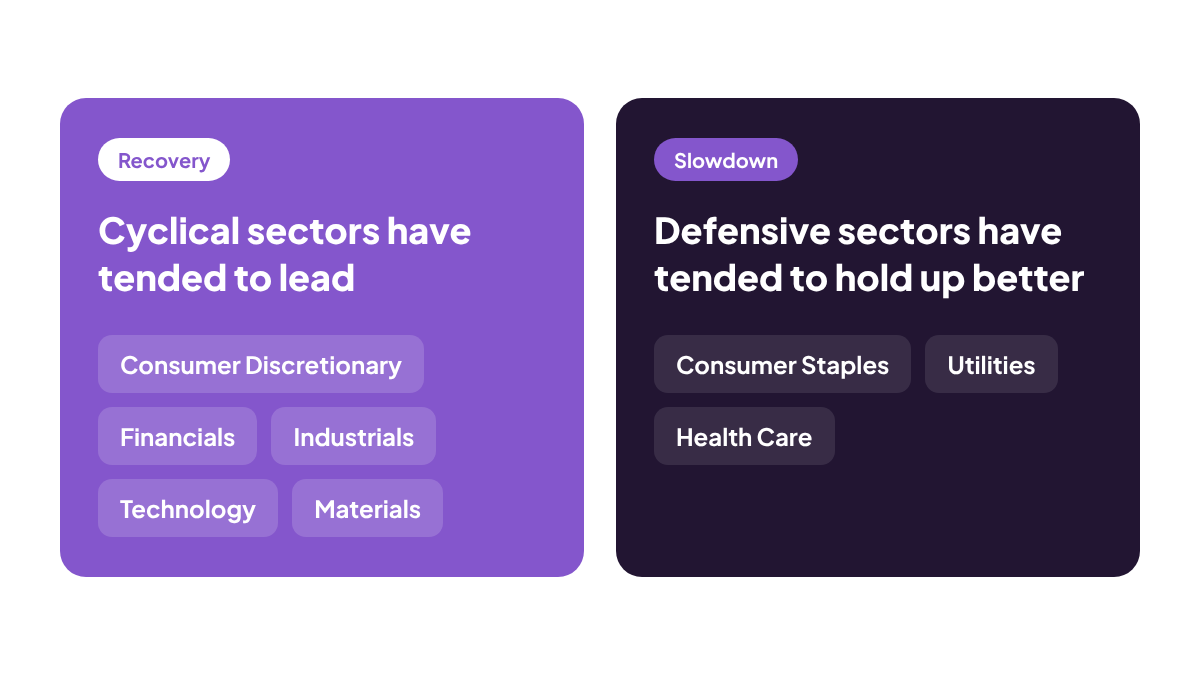
Cyclical stocks have tended to lead in recoveries, while defensive stocks have tended to hold up better in slowdowns
What Is Sector Rotation?
Sector rotation is a strategy of shifting money between sectors based on where investors think the economy is heading. For example, an investor might add cyclical sectors when they expect a recovery and move towards defensive sectors when they expect a slowdown.
It sounds simple, but it is hard to do well:
- Phases are only clear afterwards. NBER often announces the dates of peaks and troughs months after they happen.
- Markets look ahead. Stock prices often move before the economic data changes.
- Every cycle is different. Fidelity warns that sector investors can get "whipsawed" when conditions change quickly.
- Trading more can cost more. Frequent switching adds fees and can lead to buying high and selling low.
For most long-term investors, the business cycle is more useful as a way to understand why sectors move than as a timing tool. Our guide to bull and bear markets explains how market phases can affect your decisions.
Cyclical vs Defensive Stocks at a Glance
| Feature | Cyclical Stocks | Defensive Stocks |
|---|---|---|
| Link to the economy | Strong | Weaker |
| Typical behaviour in a recovery | Often rise faster | Often lag |
| Typical behaviour in a downturn | Often fall harder | Often steadier |
| Example industries | Cars, travel, banks, materials | Food, medicine, utilities |
| Main risk | Sharp falls in recessions | Slower growth and sensitivity to interest rates |
How GCC Investors Can Use Cyclical and Defensive Stocks
- Know what you own. Check which sectors your stocks and funds are in, so you understand how your portfolio may react to the economy. Our fundamental analysis guide shows where to start.
- Balance both types. Holding a mix of cyclical and defensive stocks can help reduce how much one part of the cycle affects you. See our guide on diversification.
- Consider funds for broad exposure. Sector funds hold many companies in one sector. Learn how they work in our guide to sector ETFs.
- Invest regularly instead of timing the cycle. A steady approach such as dollar-cost averaging can reduce the pressure to predict each turn.
Related Articles on Raseed Learn
Growth Stocks vs Value Stocks · How Interest Rates and the Fed Affect US Stocks · What Is a Market Correction
Build a balanced US stock portfolio
Invest in US stocks from $1 with fractional shares. US stock trading fees are 0.5% per trade, with a $0.50 minimum and a $3 maximum.
Explore US Stocks on Raseed →Frequently Asked Questions
Disclaimer
This article is for educational and informational purposes only. It is not investment advice, nor a recommendation, offer or solicitation to buy or sell any security or digital asset. Investing involves risk, including possible loss of principal. Past performance does not guarantee future results.
Securities brokerage services are provided by Fullerverse (SC) Limited, a securities broker-dealer licensed and regulated by the Financial Services Authority of Seychelles (Licence No. SD152). Fullerverse (SC) Limited is a wholly-owned subsidiary of Raseed Invest Inc. Registered address: House of Francis, Room 302, Ile Du Port, Mahe, Seychelles.
Cryptocurrency services are made available by Raseed Crypto LLC ("Raseed Crypto"), a FinCEN-registered money services business (MSB Registration No. 31000316890439) and a wholly-owned subsidiary of Raseed Invest Inc. Cryptocurrencies are not stocks and your cryptocurrency investments are not protected by either FDIC or SIPC. Cryptocurrency is highly speculative in nature and involves a high degree of risk, including volatile market price swings, market manipulation, flash crashes and cybersecurity risks. Cryptocurrency regulations are continuously evolving, and it is your responsibility to understand and abide by them. Cryptocurrency trading can lead to large, immediate and permanent loss of financial value. You should have appropriate knowledge and experience before engaging in cryptocurrency trading. For additional information, please see our Crypto Risk Disclosures (https://files.raseedcapital.com/disclosures/library/CryptoRiskDisclosures.pdf).
Cryptocurrency services are not offered by, and are not available through, Raseed Invest Limited, which is regulated by the Dubai Financial Services Authority. Products and services referenced in this article are not available in all jurisdictions and are not directed at any person in a jurisdiction where their offer or availability would be contrary to local law or regulation.