Quick Answer: How Do Interest Rates Affect US Stocks?
- The US Federal Reserve (the Fed) sets a target for the federal funds rate, which influences borrowing costs across the economy.
- Higher rates can weigh on stock prices by raising company borrowing costs, slowing spending and making future profits worth less today.
- Lower rates can support stocks by doing the opposite, although cuts made because the economy is weakening do not always lift markets.
- Markets often react to expectations, so a decision that investors already expected may move prices very little.
- Because the Saudi riyal is pegged to the US dollar, the Saudi Central Bank (SAMA) typically mirrors the Fed's rate moves, so Fed decisions also matter at home.
What You Will Learn
- What the Fed and the FOMC do
- How interest rate changes flow through to stock prices
- Why some types of stocks are more sensitive to rates
- Why Fed decisions matter for investors in Saudi Arabia
- How long-term investors can respond without trying to time the market
What Is the Fed and Who Decides Interest Rates?
The Federal Reserve is the central bank of the United States, and its Federal Open Market Committee (FOMC) decides US monetary policy. By law, the Fed aims for two goals, often called its dual mandate: maximum employment and stable prices.
According to the Federal Reserve, the FOMC has 12 members (the seven members of the Board of Governors and five of the 12 Reserve Bank presidents) and schedules eight meetings per year, about once every six weeks. It usually conducts policy by adjusting short-term interest rates, mainly through its target for the federal funds rate: the rate at which banks lend reserves to each other overnight.
How Interest Rate Changes Reach the Stock Market
The Fed explains that changes in the federal funds rate trigger a chain of events that affects other interest rates, exchange rates, the amount of money and credit and, ultimately, employment, output and prices.
For stock investors, the main channels are:
- Borrowing costs. Higher rates make loans more expensive for companies and consumers, which can slow spending and squeeze profits.
- Valuations. Investors value a stock based on the profits it may earn in the future. Higher rates make those future profits worth less in today's money.
- Competition from safer assets. When bonds and savings pay more, some investors move money out of stocks.
- The US dollar. Rate changes can move the dollar, which affects US companies that earn a lot overseas. Learn more in our guide to dollar strength (DXY).
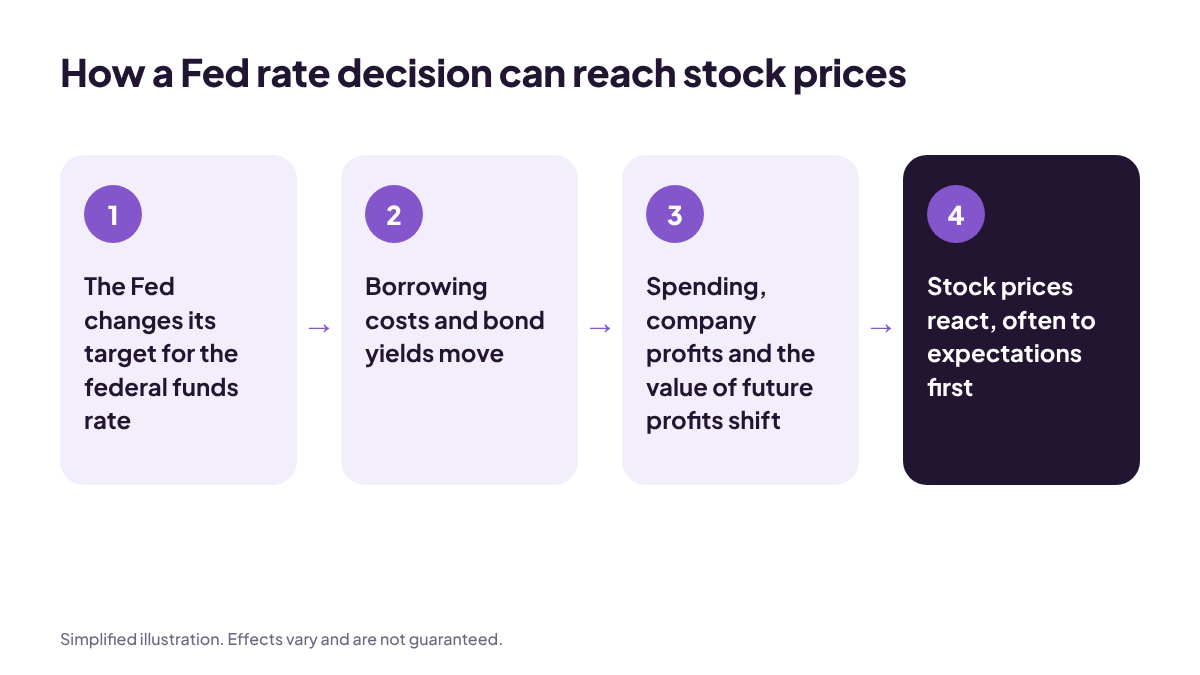
How a Fed rate decision can flow through to stock prices
Why Higher Rates Can Weigh on Stock Valuations
When rates rise, money received in the future is worth less today. This is called discounting, and it is at the heart of how investors value stocks.
| Discount Rate | Value Today of $100 Received in 10 Years |
|---|---|
| 3% | About $74.41 |
| 5% | About $61.39 |
| 7% | About $50.83 |
Calculation: $100 ÷ (1 + rate) to the power of 10. Figures rounded to the nearest cent.
The same idea explains why growth stocks, whose profits are expected further in the future, have often been more sensitive to rate changes than mature value stocks. Read more in our guide to growth stocks vs value stocks.
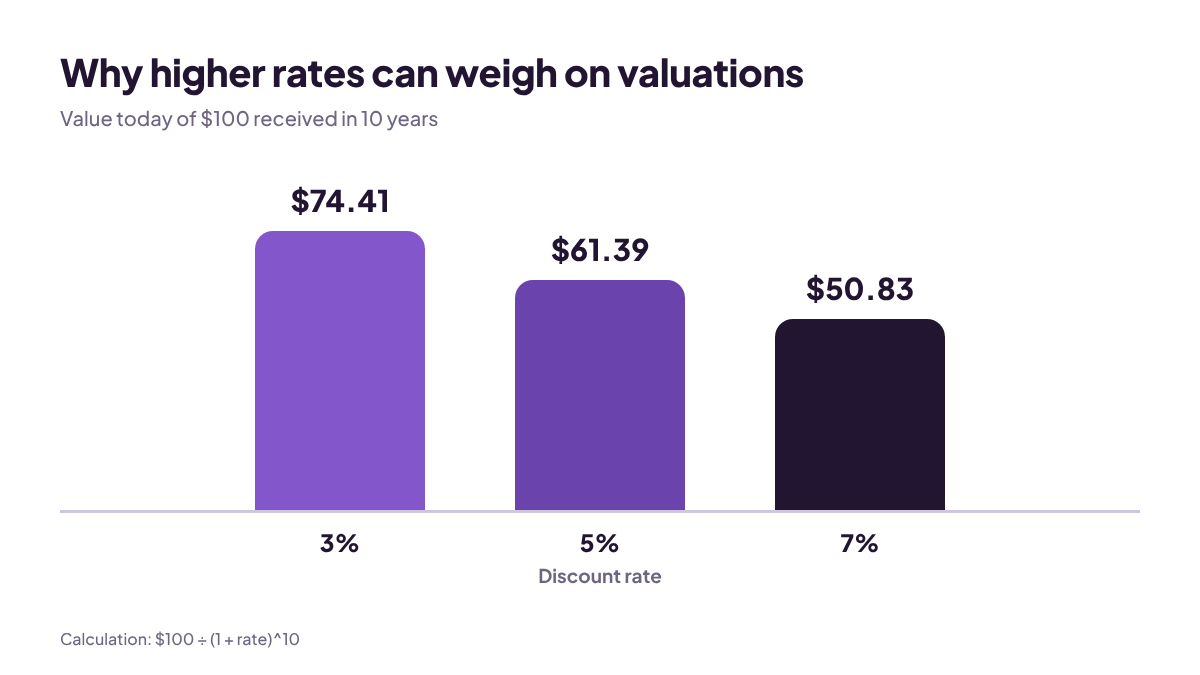
Why higher discount rates reduce the value today of future profits
Which Types of Stocks Tend to Be More Rate-Sensitive?
| Type of Company | Why Rates Matter |
|---|---|
| Fast-growing companies | More of their expected profits lie far in the future, so discounting has a bigger effect |
| Companies with heavy debt | Higher rates raise the cost of refinancing their loans |
| Real estate and utilities | Often rely on borrowing and compete with bonds for income-seeking investors |
| Banks | Higher rates can widen lending margins, but can also increase the risk of loan defaults |
These are general tendencies, not rules. Each company's results depend on its own business and finances.
Expectations Matter More Than the Headline
Stock prices often move on what investors expect the Fed to do, not just on the decision itself. If a rate cut is widely expected, much of its effect may already be reflected in prices before the announcement.
The reason behind a move also matters. A cut made because inflation is easing can be seen as positive, while a cut made because the economy is slowing sharply may come alongside falling company profits. Traders also watch the FOMC statement and the Fed chair's press conference for hints about future decisions.
Sharp market reactions to rate news can sometimes turn into a broader decline. Our guide on market corrections explains how to think about falls of 10% to 20%.
Why Fed Decisions Matter for Investors in Saudi Arabia
The Saudi riyal is pegged to the US dollar at an official rate of 3.75 riyals per dollar, and SAMA has described the peg as an anchor of monetary and financial stability. Because of this peg, SAMA typically mirrors the Fed's interest rate changes.
For GCC investors, this means a Fed decision can affect both the US stocks you hold and local borrowing and savings rates.
How Long-Term Investors Can Respond
- Avoid trying to predict every Fed decision. The timing and size of rate moves, and how markets react to them, are hard to predict.
- Stay diversified across sectors and company types so no single rate scenario dominates your portfolio.
- Focus on company quality. Businesses with strong cash flow and manageable debt tend to cope better when rates change. Our fundamental analysis guide shows what to check.
- Invest regularly. A steady approach such as dollar-cost averaging can reduce the pressure to time the market around Fed meetings.
Related Articles on Raseed Learn
What Is Dollar Strength (DXY)? · What Is a Market Correction? · Growth Stocks vs Value Stock
Build a portfolio for every rate cycle
Invest in US stocks from $1 with fractional shares. US stock trading fees are 0.5% per trade, with a $0.50 minimum and a $3 maximum.
Explore US Stocks on Raseed →Frequently Asked Questions
Disclaimer
This article is for educational and informational purposes only. It is not investment advice, nor a recommendation, offer or solicitation to buy or sell any security or digital asset. Investing involves risk, including possible loss of principal. Past performance does not guarantee future results.
Securities brokerage services are provided by Fullerverse (SC) Limited, a securities broker-dealer licensed and regulated by the Financial Services Authority of Seychelles (Licence No. SD152). Fullerverse (SC) Limited is a wholly-owned subsidiary of Raseed Invest Inc. Registered address: House of Francis, Room 302, Ile Du Port, Mahe, Seychelles.
Cryptocurrency services are made available by Raseed Crypto LLC ("Raseed Crypto"), a FinCEN-registered money services business (MSB Registration No. 31000316890439) and a wholly-owned subsidiary of Raseed Invest Inc. Cryptocurrencies are not stocks and your cryptocurrency investments are not protected by either FDIC or SIPC. Cryptocurrency is highly speculative in nature and involves a high degree of risk, including volatile market price swings, market manipulation, flash crashes and cybersecurity risks. Cryptocurrency regulations are continuously evolving, and it is your responsibility to understand and abide by them. Cryptocurrency trading can lead to large, immediate and permanent loss of financial value. You should have appropriate knowledge and experience before engaging in cryptocurrency trading. For additional information, please see our Crypto Risk Disclosures (https://files.raseedcapital.com/disclosures/library/CryptoRiskDisclosures.pdf).
Cryptocurrency services are not offered by, and are not available through, Raseed Invest Limited, which is regulated by the Dubai Financial Services Authority. Products and services referenced in this article are not available in all jurisdictions and are not directed at any person in a jurisdiction where their offer or availability would be contrary to local law or regulation.