Quick Answer: What Are the Main Types of ETFs?
- An exchange-traded fund (ETF) is a fund that holds a basket of investments and trades on a stock exchange like a share.
- Index ETFs aim to track a market index, such as the S&P 500, before fees.
- Sector and thematic ETFs focus on one industry or theme, such as technology or healthcare.
- Dividend ETFs focus on companies that pay dividends, while bond ETFs hold government or corporate bonds.
- Commodity products give exposure to assets such as gold or oil, and many are structured differently from regular ETFs.
- Leveraged and inverse ETFs aim for a multiple or the opposite of an index's daily return, and regulators warn they are generally not suited to buy-and-hold investors.
What You Will Learn
- How an ETF works
- The eight main types of ETFs and what each one holds
- The extra risks of commodity, leveraged and inverse products
- The difference between an ETF and an ETN
- What to check before choosing an ETF
What Is an ETF?
An ETF is a pooled investment fund whose shares trade on a stock exchange throughout the trading day. According to the US SEC, ETFs must register as an open-end investment company or a unit investment trust, and they are usually managed by an SEC-registered investment adviser.
When you buy one ETF share, you get exposure to every investment the fund holds. You buy and sell ETF shares through a brokerage account at the market price, which may be slightly higher or lower than the value of the fund's holdings (its net asset value, or NAV). If you are new to funds, start with our guide on stocks vs ETFs.
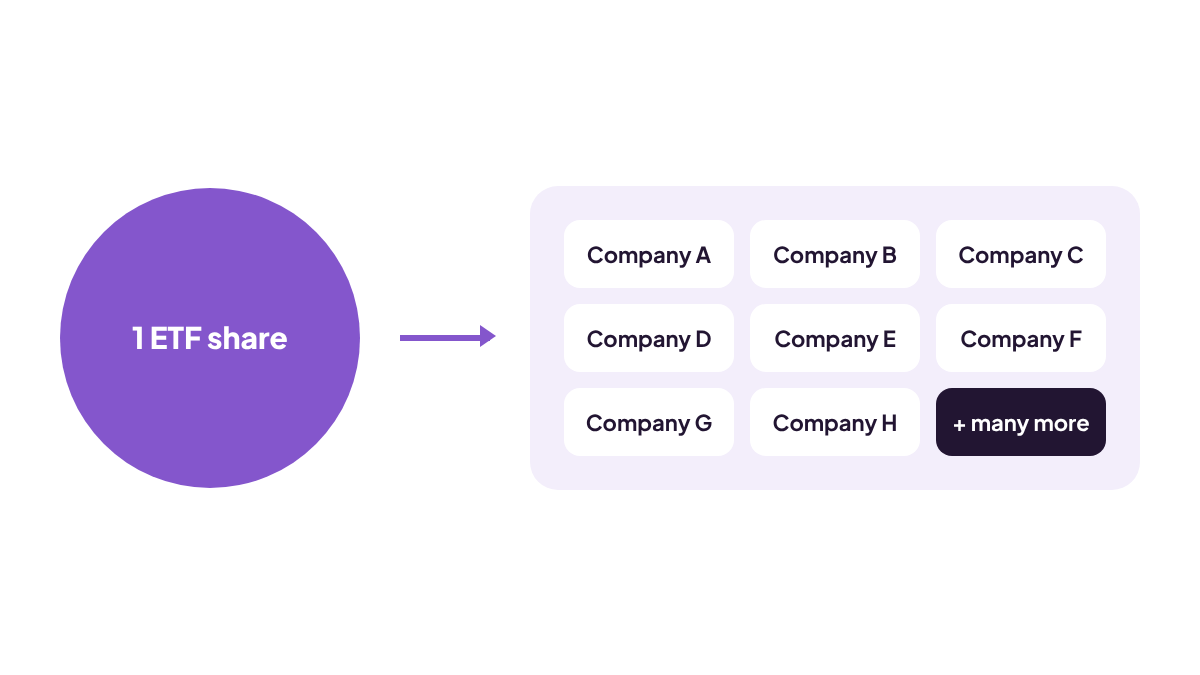
One ETF share gives exposure to a basket of many holdings
The Main Types of ETFs at a Glance
| Type of ETF | What It Holds or Aims to Do | Often Used For |
|---|---|---|
| Index ETF | Tracks a market index, such as the S&P 500 | Broad, low-cost market exposure |
| Sector and thematic ETF | Companies in one industry or theme | Targeting a specific part of the economy |
| Dividend ETF | Companies selected for their dividends | Income-focused investing |
| Bond ETF | Government or corporate bonds | Income and lower-volatility exposure |
| International and regional ETF | Companies outside the US or in a specific region | Geographic diversification |
| Commodity ETF or ETP | Commodities such as gold or oil, or futures on them | Exposure to raw-material prices |
| Actively managed ETF | Investments chosen by a manager, not tied to an index | Seeking to beat a benchmark |
| Leveraged and inverse ETF | Derivatives that aim for a multiple or the opposite of a daily index return | Short-term trading |
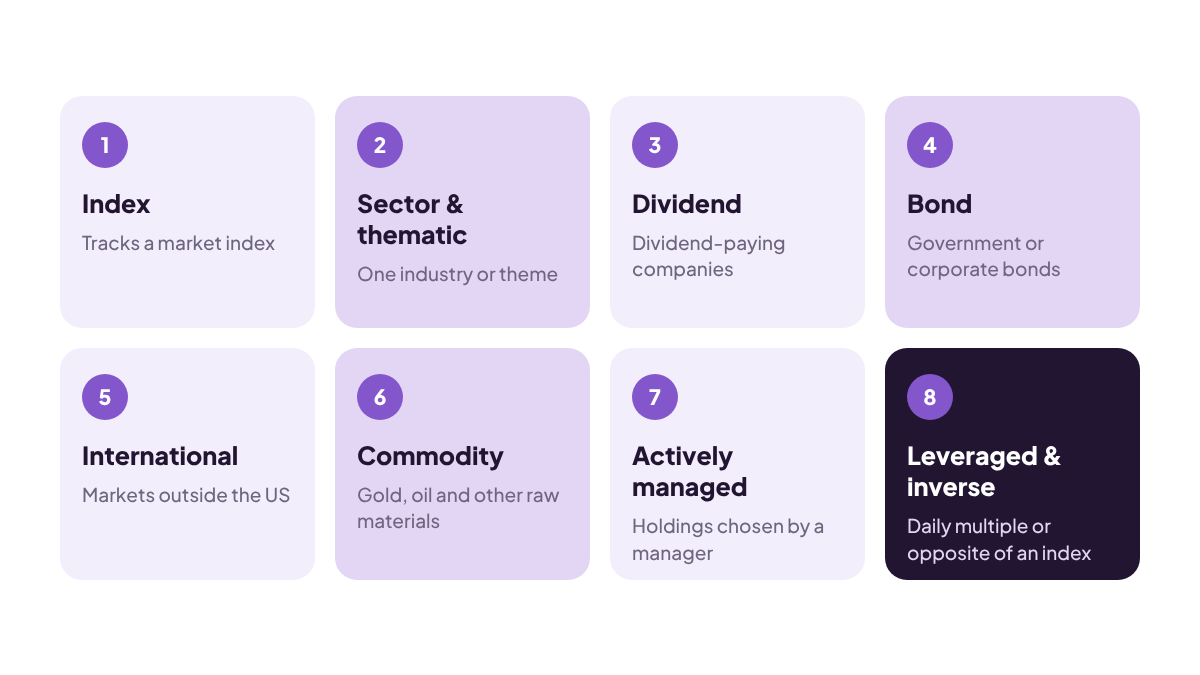
The eight main types of ETFs and what each one focuses on
1. Index ETFs
Index ETFs are passive funds that aim to deliver approximately the same return as a particular index, before fees. Examples include funds that track the S&P 500 or the Nasdaq-100. Because they follow a set list of companies, they usually have lower costs than actively managed funds. Learn more in our guides to stock market indices and investing in index funds.
2. Sector and Thematic ETFs
Sector ETFs hold companies from one industry, while thematic ETFs focus on a trend such as artificial intelligence or clean energy. They let you target a specific area, but they are less diversified than a broad index fund, so they can rise or fall more sharply. Our guide to sector ETFs explains how they work.
3. Dividend ETFs
Dividend ETFs hold companies selected for paying or growing their dividends. They are popular with income-focused investors. Payouts depend on the companies in the fund and can change. For non-US investors, dividends from US companies are generally subject to US withholding tax. Read our guide on all about dividends.
4. Bond ETFs
Bond ETFs hold a portfolio of bonds, such as US government Treasuries or corporate bonds. They aim to provide income, and their prices tend to move in the opposite direction to interest rates. Unlike an individual bond, most bond ETFs do not have a maturity date, because the fund keeps replacing the bonds it holds.
5. International and Regional ETFs
International ETFs hold companies listed outside the US, either worldwide, in one region or in a single country. They can add geographic diversification, but they also carry currency risk and the political and economic risks of the countries they invest in.
6. Commodity ETFs and ETPs
Commodity products give exposure to raw materials such as gold, silver or oil. Some hold the physical commodity, while others use futures contracts. The SEC notes that exchange-traded commodity trusts are not registered as investment companies under the Investment Company Act of 1940, even if they are called ETFs. This means they do not have the same investor protections as regular ETFs, so it is important to read the prospectus.
7. Actively Managed ETFs
Actively managed ETFs are run by a manager who chooses the investments instead of tracking an index. The goal is usually to beat a benchmark, but there is no guarantee the manager will succeed, and costs are often higher than for index ETFs. Our ETF vs mutual fund guide explains how ETF costs compare with other funds.
8. Leveraged and Inverse ETFs
Leveraged ETFs aim to deliver a multiple of an index's return, such as 2x or 3x, while inverse ETFs aim to deliver the opposite. According to FINRA, the vast majority reset their exposure every day, so their returns over longer periods can be very different from the multiple you might expect.
FINRA gives this example: an index falls 10% on day one and rises 10% on day two, ending down 1%. A 2x leveraged product worth $100 falls to $80 and then rises to $96, a loss of 4%. FINRA warns that these products can be risky long-term or even medium-term investments.
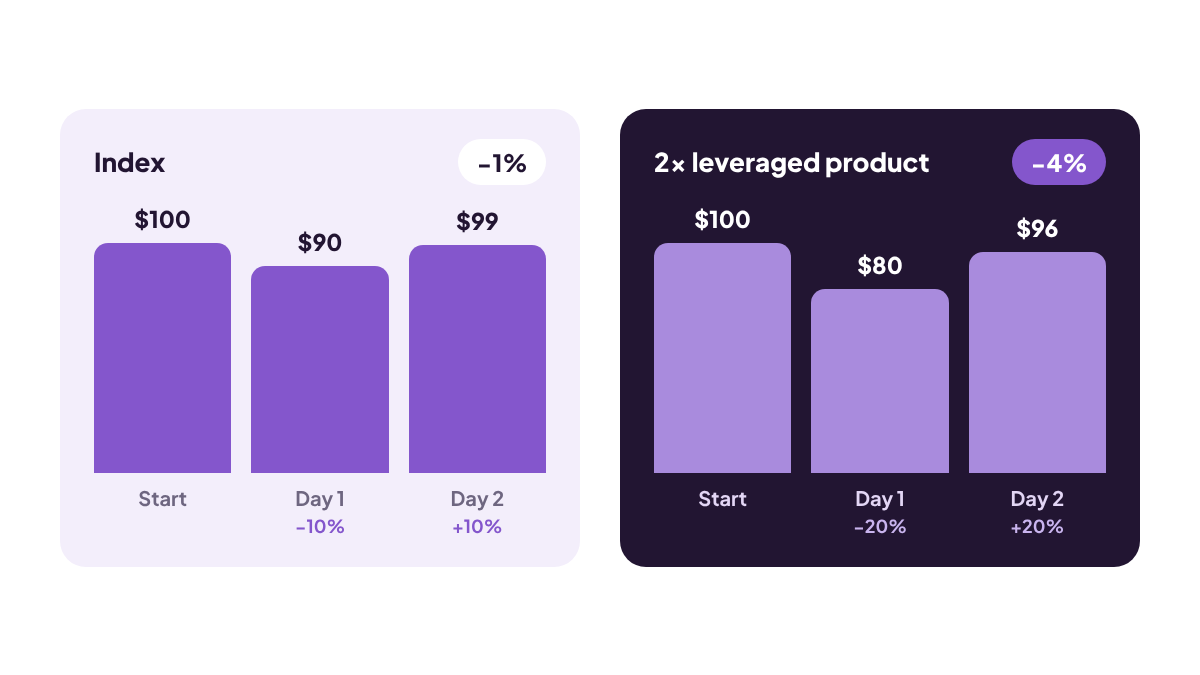
A 2x daily leveraged product can lose more than twice the index over two days (FINRA example)
ETFs vs ETNs: An Important Difference
An exchange-traded note (ETN) is not a fund. The SEC describes ETNs as unsecured debt obligations of financial institutions. An ETN does not own a portfolio of assets, so if the issuer runs into financial trouble, you could lose your entire investment. ETNs can look similar to ETFs on a trading screen, so always check what you are buying.
What to Check Before Choosing an ETF
- What it holds. Read the fund's holdings and its investment objective.
- Costs. Check the expense ratio and the difference between buy and sell prices.
- Size and trading volume. Larger, more actively traded ETFs usually have tighter spreads.
- Structure. Confirm whether it is an ETF, a commodity trust or an ETN.
- How it fits your portfolio. Avoid holding several ETFs that own the same companies. See our guide on diversification.
- Shariah screening, if it matters to you. Our guide to halal ETFs explains what screened funds look for.
Related Articles on Raseed Learn
Build your portfolio with US-listed ETFs
Trade US stocks and ETFs on Raseed. Fees are 0.5% per trade, with a $0.50 minimum and a $3 maximum.
Explore US Stocks and ETFs on Raseed →Frequently Asked Questions
Disclaimer
This article is for educational and informational purposes only. It is not investment advice, nor a recommendation, offer or solicitation to buy or sell any security or digital asset. Investing involves risk, including possible loss of principal. Past performance does not guarantee future results.
Securities brokerage services are provided by Fullerverse (SC) Limited, a securities broker-dealer licensed and regulated by the Financial Services Authority of Seychelles (Licence No. SD152). Fullerverse (SC) Limited is a wholly-owned subsidiary of Raseed Invest Inc. Registered address: House of Francis, Room 302, Ile Du Port, Mahe, Seychelles.
Cryptocurrency services are made available by Raseed Crypto LLC ("Raseed Crypto"), a FinCEN-registered money services business (MSB Registration No. 31000316890439) and a wholly-owned subsidiary of Raseed Invest Inc. Cryptocurrencies are not stocks and your cryptocurrency investments are not protected by either FDIC or SIPC. Cryptocurrency is highly speculative in nature and involves a high degree of risk, including volatile market price swings, market manipulation, flash crashes and cybersecurity risks. Cryptocurrency regulations are continuously evolving, and it is your responsibility to understand and abide by them. Cryptocurrency trading can lead to large, immediate and permanent loss of financial value. You should have appropriate knowledge and experience before engaging in cryptocurrency trading. For additional information, please see our Crypto Risk Disclosures (https://files.raseedcapital.com/disclosures/library/CryptoRiskDisclosures.pdf).
Cryptocurrency services are not offered by, and are not available through, Raseed Invest Limited, which is regulated by the Dubai Financial Services Authority. Products and services referenced in this article are not available in all jurisdictions and are not directed at any person in a jurisdiction where their offer or availability would be contrary to local law or regulation.