A Practical Guide to Sustainable and Responsible Investing for Saudi and GCC Investors
ESG investing in Saudi Arabia is not just about ethical preferences, it is increasingly aligned with where government policy, institutional capital, and long-term economic strategy are pointing.
ESG stands for Environmental, Social, and Governance, a framework for evaluating companies not only on financial metrics but on their impact on the environment, their treatment of employees and communities, and the quality of their corporate leadership and transparency. Globally, ESG has evolved from a niche ethical consideration to a mainstream investment framework used by sovereign wealth funds, pension funds, and retail investors alike.
For Saudi and GCC investors in 2026, ESG carries an additional dimension: Vision 2030. Saudi Arabia's national transformation plan targets economic diversification away from oil, renewable energy at 50% of the electricity mix by 2030, and significant climate commitments. Companies that align with these targets may attract regulatory clarity and international institutional capital making ESG alignment a financial as well as ethical consideration.
Quick Answer: What Is ESG Investing in Saudi Arabia and the GCC?
ESG investing evaluates companies on Environmental (climate impact), Social (employee treatment, community), and Governance (transparency, leadership) criteria alongside financial returns
Saudi Arabia's Vision 2030 explicitly targets sustainability, renewable energy (50% of electricity by 2030), and economic diversification, making ESG directly relevant to national policy direction
The Saudi Exchange issued ESG Disclosure Guidelines in 2021 to help listed companies improve sustainability reporting driving growing improvement in data availability for GCC ESG investors
Under the Saudi Green Initiative, the first wave of more than 60 initiatives represents over SAR 700 billion in investments intended to support the growth of the green economy
Global ESG assets under management were projected to grow from $18.4 trillion in 2021 to $33.9 trillion by 2026, per PwC Global ESG research reflecting broader institutional momentum that is also influencing GCC markets
How ESG Works: The Three Pillars
Each ESG pillar captures a different dimension of corporate behaviour that investors and analysts consider alongside financial metrics.
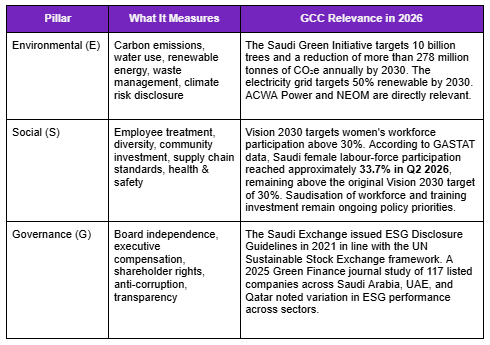
ESG in Saudi Arabia: What Has Changed
Saudi Arabia's ESG landscape has developed significantly, driven by Vision 2030 policy direction and the need to attract international institutional capital.
The Saudi Exchange issued ESG Disclosure Guidelines in 2021 to help listed companies navigate ESG reporting and improve sustainability-related disclosures.The CMA and the Saudi Exchange are separate entities: the CMA is the capital markets regulator, while the Saudi Exchange (Tadawul) is the operator of the market infrastructure. ESG disclosure guidance for listed companies comes from the Saudi Exchange.
A Green Finance study published in 2025 examined 117 companies across Saudi Arabia, the UAE, and Qatar using 2021–2022 data. The study found that ESG performance generally improved across the three countries during the study period, with the UAE showing the most substantial progress and Saudi Arabia showing moderate improvements associated with Vision 2030 and ongoing reforms.
The scale of Saudi climate commitments is significant. Under the Saudi Green Initiative, the first wave of more than 60 initiatives represents over SAR 700 billion in investments intended to support the growth of the green economy, with a goal of reducing more than 278 million tonnes of CO₂e annually by 2030. The NEOM Green Hydrogen Project, a joint venture between ACWA Power, Air Products, and NEOM is among the most prominent green hydrogen developments in the region. These commitments are backed by government mandates and sovereign capital from the Public Investment Fund (PIF), which manages more than $900 billion in assets.
ESG and Shariah Compliance — How They Relate
ESG and Islamic finance share some common ground but are distinct frameworks with different methodologies, criteria, and purposes. They should not be treated as interchangeable.
ESG is not a single, unified screening standard, it is a broad category of approaches, and different ESG rating agencies and fund managers apply different methodologies, weightings, and data sources. Two funds both labelled "ESG" can hold significantly different portfolios and exclude different industries. Some ESG strategies apply negative screens similar to those in Sharia screening (excluding alcohol, gambling, weapons); others focus primarily on carbon emissions or governance scores without industry exclusions. Before assuming any ESG fund aligns with your values, review its specific methodology documentation.
Some ESG strategies use sector exclusions that may overlap with Shariah screening, including restrictions on industries such as tobacco, weapons, alcohol, or gambling. However, these exclusions are not universal across ESG funds, and ESG methodologies vary significantly between providers. Shariah screening follows defined business-activity and financial-ratio criteria, while ESG strategies may use exclusions, scoring systems, best-in-class selection, or other approaches.
Traditional Sharia equity-screening methodologies generally focus on business activities and financial-ratio criteria and do not typically use environmental metrics as core eligibility criteria. A company may therefore pass a Sharia equity screen while having weak environmental disclosure, while a company with strong ESG credentials may fail Sharia business-activity or financial-ratio requirements. Passing one framework does not imply passing the other.
For investors who want both Sharia compliance and ESG alignment, dedicated funds that explicitly apply both frameworks are available but the key word is "explicitly." Always verify what a fund's prospectus and methodology documentation actually state before assuming a combined screen is in place.
How to Incorporate ESG into a GCC Portfolio
Practical ESG investing for Saudi and GCC investors can be implemented at three levels of engagement.
Level 1 — Sector Exclusion
The simplest approach: avoid sectors that conflict with your ESG values. For most GCC investors, this typically means avoiding conventional tobacco, weapons, alcohol, and heavily polluting industries. On TASI, this naturally overlaps with existing halal screening practices though the two are not identical.
Level 2 — ESG- or Sharia-Screened ETFs
A growing number of ETFs apply systematic ESG or Sharia screens to their holdings. Two examples relevant to Saudi investors:
SPUS (SP Funds S&P 500 Sharia Industry Exclusions ETF ) applies Sharia screening to a US large-cap universe. Review SP Funds' methodology documentation to understand the specific criteria applied. Whether it additionally incorporates ESG criteria should be confirmed against the current fund prospectus, do not assume a combined Sharia + ESG screen without verification
HLAL (Wahed FTSE USA Shariah ETF) officially tracks the FTSE Shariah USA Index. Review Wahed Invest's methodology documentation. As with SPUS, whether ESG criteria are applied in addition to Sharia screening should be confirmed against current fund documentation before treating it as an ESG strategy
Regarding the iShares MSCI Saudi Arabia ETF (ticker: KSA): This fund tracks the MSCI Saudi Arabia IMI 25/50 Index not TASI directly and provides exposure to Saudi-listed equities weighted by market capitalization. It is not marketed as an ESG fund and does not apply a dedicated ESG overlay unless explicitly confirmed in the current fund factsheet. Check the iShares fund factsheet directly before treating this as an ESG investment.
Before investing in any ETF through Raseed, verify that the specific fund is currently available on the platform and eligible for investment at the minimum amount applicable to your account.
Level 3 — ESG Research on TASI
For investors with the capacity to engage more deeply, TASI-listed companies such as ACWA Power operate in sectors that are structurally relevant to Vision 2030's renewable energy targets. Individual company sustainability reports and ESG disclosures, together with relevant Saudi Exchange disclosures where available, provide important sources for evaluating specific TASI-listed companies on ESG criteria.When reviewing named companies, distinguish between what companies have disclosed versus what has been independently verified and be aware that ESG scores for the same company can vary between rating providers due to methodological differences.
→ Open your Raseed Invest account to access US-listed ETFs and stocks from Saudi Arabia
Frequently Asked Questions
Q: Does ESG investing sacrifice returns compared to traditional investing?
Academic research on ESG and financial returns is mixed and continues to evolve. Some meta-analyses have found that ESG portfolios performed comparably to non-ESG benchmarks over certain periods, while others have found underperformance in specific categories or time horizons. Strong governance in particular has been associated with lower incidence of corporate scandals, which may support long-term value preservation. However, there is no consensus that ESG portfolios systematically outperform, and past performance of ESG strategies in other markets does not guarantee results in GCC-specific or Saudi market contexts. Evaluate ESG as one factor among many not as a reliable performance predictor.
Q: Are there ESG or Sharia-screened funds accessible to Saudi investors?
Several internationally listed ETFs apply Sharia screening and are relevant to Saudi investors. SPUS and HLAL are examples of Sharia-screened ETFs. Whether either fund additionally applies ESG criteria and how should be confirmed by reviewing their current fund documentation and prospectuses, as fund methodologies can change over time. Availability of specific ETFs through Raseed should be verified directly on the platform before investing.
Q: How do I know if a TASI-listed company is genuinely ESG-compliant?
The Saudi Exchange ESG Disclosure Guidelines (2021) provide a framework encouraging listed companies to publish sustainability reports. Review the company's sustainability disclosure on the Saudi Exchange website and look for specific, quantified metrics: carbon intensity figures, water usage data, employee diversity ratios, and board independence statistics. Vague sustainability statements without numerical disclosures are a governance warning sign. Be aware that "ESG-compliant" is not a binary status companies disclose to different standards and ESG ratings vary between providers.
Q: How do I evaluate the ESG credentials of a specific TASI-listed company?
Start with the company's own sustainability report or ESG disclosures published on its corporate website, and review relevant Saudi Exchange disclosures where available. Look at which ESG pillars the company prioritises and how it quantifies its performance. Cross-reference against any available third-party ESG ratings, bearing in mind that different rating providers use different methodologies. For companies operating in Vision 2030-aligned sectors such as renewable energy, healthcare, or technology, review how their actual business operations, not just stated commitments, connect to the specific ESG criteria you are evaluating. Avoid relying on a single ESG score or label as a definitive verdict.
Related Articles on Raseed Invest Learn
Disclaimer
This article is for educational and informational purposes only. It is not investment advice, nor a recommendation, offer or solicitation to buy or sell any security or digital asset. Investing involves risk, including possible loss of principal. Past performance does not guarantee future results.
Securities brokerage services are provided by Fullerverse (SC) Limited, a securities broker-dealer licensed and regulated by the Financial Services Authority of Seychelles (Licence No. SD152). Fullerverse (SC) Limited is a wholly-owned subsidiary of Raseed Invest Inc. Registered address: House of Francis, Room 302, Ile Du Port, Mahe, Seychelles.
Cryptocurrency services are made available by Raseed Crypto LLC ("Raseed Crypto"), a FinCEN-registered money services business (MSB Registration No. 31000316890439) and a wholly-owned subsidiary of Raseed Invest Inc. Cryptocurrencies are not stocks and your cryptocurrency investments are not protected by either FDIC or SIPC. Cryptocurrency is highly speculative in nature and involves a high degree of risk, including volatile market price swings, market manipulation, flash crashes and cybersecurity risks. Cryptocurrency regulations are continuously evolving, and it is your responsibility to understand and abide by them. Cryptocurrency trading can lead to large, immediate and permanent loss of financial value. You should have appropriate knowledge and experience before engaging in cryptocurrency trading. For additional information, please see our Crypto Risk Disclosures (https://files.raseedcapital.com/disclosures/library/CryptoRiskDisclosures.pdf).
Cryptocurrency services are not offered by, and are not available through, Raseed Invest Limited, which is regulated by the Dubai Financial Services Authority. Products and services referenced in this article are not available in all jurisdictions and are not directed at any person in a jurisdiction where their offer or availability would be contrary to local law or regulation.