


Banking, Energy, Healthcare, Real Estate — Compared for 2026
Quick Answer: Which TASI Sectors Are Best for GCC Investors in 2026?
Banking is the largest non-energy sector and benefits from Vision 2030 infrastructure spending and rising domestic lending
Healthcare is the fastest-growing sector for Vision 2030 alignment, with companies like Dr. Sulaiman Al Habib showing consistent earnings growth
Energy (excluding Aramco) underperformed in 2024–2025 due to oil price pressure but offers high dividend yields
Utilities (ACWA Power) were the strongest TASI contributor in 2024, driven by Saudi renewable energy buildout
Real estate is a Vision 2030 play but is interest-rate sensitive, performance depends on Saudi government housing programs
What you will learn in this article
How TASI divides into sectors and which are the largest
The specific case for banking, energy, healthcare, utilities, and real estate
Which sectors have the highest dividend yields vs growth potential
What Vision 2030 means for sector allocation in a Saudi portfolio
How to diversify across TASI sectors without concentrating in Aramco
Banking and utilities were the two strongest TASI sectors by contribution in 2024, while energy (dominated by Aramco) underperformed due to lower oil prices.
The TASI index contains more than 266 listed stocks across 21 sectors. For most retail investors, meaningful TASI analysis concentrates on five core sectors: banking, energy, healthcare, utilities, and real estate. Together these account for the large majority of TASI's non-Aramco market cap and drive the index's day-to-day performance outside of oil price moves.
This guide focuses on sector-level fundamentals and Vision 2030 alignment. For a company-by-company analysis of the 10 largest TASI stocks, see our Top 10 TASI Stocks by Market Cap guide.
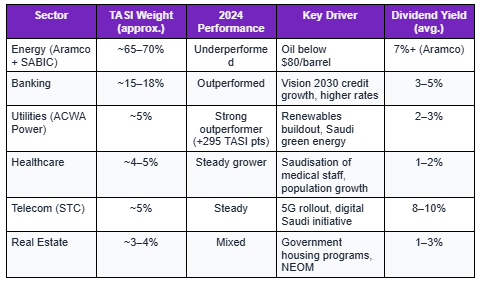
Banking Sector — The Largest Non-Energy Opportunity
Saudi banks benefit from three structural tailwinds: Vision 2030 infrastructure lending, rising domestic consumer credit, and the Saudi government's strong fiscal position.
The Saudi banking sector is the second-largest component of TASI by market cap after energy, and arguably the most directly linked to Vision 2030's spending programs. Major infrastructure projects NEOM, Red Sea, Qiddiya — require massive construction financing that flows through Saudi banks. Al Rajhi Bank, SNB, Riyad Bank, and Alinma Bank are the primary beneficiaries.
Banking stocks were in Argaam's "improving quadrant" on the RRG chart as of end-2024, indicating recovery in momentum. The sector benefits from Saudi Arabia maintaining higher interest rates alongside the Federal Reserve due to the SAR-USD peg, which widens net interest margins.
Investment note: For GCC investors specifically, Al Rajhi Bank and Alinma Bank are full Islamic banks operating on profit-sharing principles rather than interest. This gives them a structurally different AAOIFI compliance profile compared to conventional banks like SNB, where the Sharia screening may vary by methodology.
Energy Sector — High Yield but Oil-Price Dependent
Aramco's 7%+ dividend yield is one of the highest of any major company globally, but its share price moves with oil prices, making it a commodity play as much as a stock.
The energy sector's dominance in TASI (~65–70%) means that any individual stock-picking within TASI is fighting against Aramco's gravitational pull. When oil prices fell below $60/barrel in April 2025, Aramco lost approximately $90 billion in market cap in a single episode. For investors who want TASI exposure without this concentration, deliberate sector diversification, overweighting banks, healthcare, and telecom relative to their TASI weights is the standard approach.
Healthcare Sector — The Vision 2030 Growth Play
Saudi healthcare is one of the clearest Vision 2030 plays in the market, growing domestic demand, mandatory Saudisation of medical roles, and significant government investment.
Dr. Sulaiman Al Habib Medical Services Group is the largest and most followed healthcare stock on TASI. It has delivered consistent earnings growth driven by hospital expansion, a growing private healthcare market, and the broader shift from reliance on imported medical expertise to domestic capacity. The healthcare sector sits in a lower-correlation position relative to oil prices, making it a natural diversifier for TASI portfolios that are already overweight energy through Aramco.
Utilities Sector — The Biggest 2024 Outperformer
ACWA Power contributed 295 index points to TASI's 2024 gains, the largest single contributor — driven by Saudi Arabia's aggressive renewable energy buildout.
Saudi Arabia has committed to sourcing 50% of its electricity from renewable sources by 2030 as part of Vision 2030. ACWA Power is the primary listed vehicle for this transition, developing solar, wind, and water desalination projects. The utilities sector showed the strongest relative strength and momentum (leading quadrant in Argaam's RRG sector analysis, end-2024) and carries lower oil-price correlation than the broader TASI index.
Real Estate Sector — Vision 2030 Housing Programs
Real estate is a direct Vision 2030 play but is sensitive to interest rates and project execution timelines.
Saudi Arabia's housing programs including Sakani, which provides subsidised housing to Saudi citizens, support underlying demand for real estate development. However, the sector is rate-sensitive (higher rates make mortgage financing more expensive) and project-execution-dependent. NEOM and Red Sea mega-project timelines have faced delays, which creates uncertainty for real estate developers exposed to those developments. Companies like Dar Al Arkan and Jabal Omar are the primary listed real estate vehicles on TASI.
Frequently Asked Questions
Q: What is the best TASI sector for dividend income?
Telecom (STC: ~10% yield) and Energy (Aramco: ~7%) offer the highest dividend yields. Banking stocks offer 3–5% yields with more consistent earnings growth. Healthcare and utilities offer lower yields but stronger capital growth potential.
Q: Which TASI sector is most linked to Vision 2030?
Healthcare and utilities (ACWA Power for renewables) have the most direct Vision 2030 alignment. Banking benefits indirectly through infrastructure financing. Real estate benefits from government housing programs.
Related Articles on Raseed Learn
5 Steps to Diversify Your Portfolio
This article is for educational and informational purposes only and does not constitute investment advice. All investing involves risk including the potential loss of principal. Data is from publicly available sources as of June 2026. Past performance does not guarantee future results. Securities brokerage services are provided by Fullerverse (SC) Limited, licensed and regulated by the Financial Services Authority Seychelles (Licence No. SD152), a wholly-owned subsidiary of Raseed Invest Inc. Raseed Invest Limited is regulated by the DFSA. Capital is at risk.